"Could I have this dance for the rest of my life?" - Anne Murray

Tuesday, January 15, 2013

Historic Charleston, SC


 Several times since we arrived here almost a month ago, we've taken the 20 minute drive into Charleston to see a little more each time of this beautiful city. Charleston has recently been selected by Conde Nast as the top tourist location in the USA and the top city in the world!  It has a rich history that is evident at almost every turn, except maybe this one:


This is the new Ravenel Bridge that links Mt. Pleasant and Charleston, so we have to cross it every time we go into the city (no tolls!). It's an inspiring bridge and we can see it from much of Mt. Pleasant.  At the peak of the bridge you get an expansive view of the Cooper River, Charleston harbor, the USS Yorktown, and Ft. Sumter, the site of the first shots of the Civil War. 

On our first trip into the city we wanted to see the famously beautiful ceiling of the Unitarian Church.  There are some exquisite pictures if it and others at a website called Churches of America, which I'd highly recommend even if you aren't into churches. We had read online that the church was open every Friday and Saturday for a few hours. 

 So one Friday we found our way there, found parking (which is not easy in Charleston) and found that the church was not open on Fridays after all.  Well, we enjoyed the outside instead, along with the Lutheran Church next door.


It was a beautiful day, as you can see, so we wandered around a bit practicing our architectural photography. We've been photographing nature scenes for so long; buildings are really different. Because Charleston is an old city, the streets are narrow, and it's hard to get very far away from your subject. Some of these close angles worked out well against the clear blue sky. 

The typical Charleston home is called a "single," with a single row of rooms on two or three floors. The homes were built this way to maximize cross ventilation in each room. They often have the narrow side facing the street, and many have porches built on the wide side, making them look like they're sitting sideways. 


For Christmas, my son Mark and his girlfriend Ahna gave us tickets to a History and Homes Tour with the Old Charleston Tours company. So a few days ago we drove back over the Ravenel Bridge, lucked out with a free parking spot on the street and met our tour guide in Washington Park on Broad St.  She was very knowledgable about the history of the city, even more so because she grew up here.  She has lots of fun anecdotes about how much the city has changed just in her lifetime. 

The day was not so beautiful; it was overcast with a pale grey sky.  I know that some photographers really like overcast skies, but I haven't got the hang of it. Photos on these overcast days always look kind of pale or dingy to me. Anyway, we started at the "Four Corners of the Law" (Broad and Meeting St.) where each corner has a building representing a branch of law (church, county, city and federal).  In this picture a woman is selling sweet grass baskets in front of what I think is the federal building. 


The tour walked us through one of the oldest residential areas of the city, with classic Charleston homes, churches and commercial buildings. The photo below shows the wrought iron work that Charleston is known for, much of it, like this example, is over 200 years old.


The "War Between the States," or what Northerners call the Civil War, was very hard on Charleston, and many buildings were damaged or destroyed. Then, as Charleston was well on its way to recovery, the big earthquake of 1886 devastated much of the city once again. Many of the old buildings have these braces running through them, with caps like those below visible on the outside.  Sometimes they just look like architectural details, with lion's heads and the like. 


These periods of destruction (most recently topped by the damage done by Hurricane Hugo) have had a  dramatic impact on the architecture in Charleston. Each event gave the town the opportunity to reinvent itself, but it never losses sight of its heritage. Our guide told a a joke: What do Charlestonian's and Asians have in common? They both eat rice and they both worship their ancestors. (I hope that's not an offensive joke - none intended) We have certainly seen a lot of historical portraits in these old homes, and heard a lot about rice agriculture.

This house is a large single with a porch that was probably added on later. Our guide told us that the singles did not originally have porches. Why not??  Tours in horse drawn carriages are also a popular tradition here.


We finished our tour at the Edmondston-Alston House. It is a home that has been preserved and filled with antiques, 90% of which have belonged to the Edmundston or Alston families.  One of the Alston's still lives on the third floor.


We couldn't take any photos inside, but we could take them on and from the porch.  The front of the house has wrought iron trim, and provides a view of the Battery - the road that runs along the harbor.


We got a birds eye view of their garden.


On another day in the city I saw what I think was a carriage house, or maybe a gate house, that is now part of the College of Charleston.  A lot of the buildings in Charleston are pink. 


Back out in Mount Pleasant, we intended to visit Boone Hall, but it was closed for the month. Luckily, right across the street was the Charles Pinckney National Historic Site, so we got a little outing anyway.  The only remaining structure on the site in this idyllic southern home, what we would call a "cape." Is that the right name here in the south?


Many of these plantations and homes have joggling boards, which I loved bouncing on. The story is that they were based on a design from Scotland, built to provide a little bit of movement for a woman incapacitated with arthritis. I imagine they probably got more use by children.


Speaking of children, grandniece Caroline thought the Angel Oak was the best playground ever.


We thought it was pretty grand too. It is said to be as much as 1500 years old.


Today we leave Mount Pleasant, with loving family memories, a greater understanding of why Charleston is such a popular destination, and an appetite for shrimp and grits well satisfied. We're sad to say goodbye to our family here. It's been so long since we've been near family and it began to feel like home. Maybe someday it will be. Who knows?

Next stop: Edisto Beach State Park.

Sunday, January 13, 2013

Fog Bow on Isle of Palms, SC

Look what Rick, brother Bob, friend Cathy and I saw today as we walked the beach on Isle of Palms! 


Thank you Cathy for catching this on your iPhone! It's called a fog bow and is just like a rainbow, except that because the particles are so uniformly small they make a white bow rather than colored. It, like others of its kind, does have a little pink and blue in it. They are relatively rare, but happen more often near or on the ocean, and in the Arctic. 

Saturday, January 12, 2013

Mount Pleasant KOA

While here in Mount Pleasant, SC, we're staying at the KOA. Although KOA's are not our favorite spots, we chose this one because it's close to family and Charleston, and we've been happy with it. KOA's are often pricey, overburdened with rules, and one pays for lots of amenities and activities that are aimed at families with children.  This one is very relaxed and reasonable for the monthly rate of $508, which includes taxes and electricity.  It is located on the Oakland Plantation, a very large historic tract of land that still has the original home, which you can see on a biweekly wagon ride.  What I like best about this KOA is the long nature trail along through the undeveloped parts of the property. Kona and I walk it often. I thought I'd share some pictures of a quiet day at the KOA.


 An early start around the trail resulted in some nice hazy morning scenes. The live oaks, Spanish moss and palms create the typical Southern silhouettes.


The path through the property follows several long ditches that seem to be effected by the tides. Signs at the start of the trail warn walkers to stay on the trail due to alligators and poisonous snakes! I haven't seen any, but it's winter.


Many egrets and herons live along the ditches and are always startled by our walking by. The herons make a really loud squawk that has startled me more than once, even though I've come to expect it.


Here you can just see one sitting up in the bare branches to the right of the palm.


The path also goes through a couple of areas with smaller low hanging trees, lots of vines and palmetto undergrowth.


It was still early enough that I caught the light on some dewey spider webs...


twigs...


and this fascinating unidentified plant.  It was the only one like it - about a foot tall, with purple and dark green foliage. 


The path ends with a stretch along the fresh water lake.


Back at the campground, here's our site, #29. Nothing special really.


Next to the office there's a swimming pool covered with a bubble. We haven't tried it out. 


Today I'm alone in the RV while Rick helps the family out with some furniture moving. I'm baking bread, doing laundry and writing this post. 


A few times this month we've had some nice sunsets over the lake.  Is this the life or what? Tonight however we won't be here. We'll be at Carolina's Restaurant in Charleston, celebrating Rick's brother Bob's birthday. We leave in a few days, but I still hope to write a post or two about the things we've been doing and seeing here. We'll see...

Sunday, December 30, 2012

Brookgreen Gardens, South Carolina

Another new adventure made possible by a generous gift from the family! We loaded up in niece Sarah and her husband Michael's mini-van and headed up north Rt. 17, past Georgetown and Pawley's Island to Brookgreen Gardens.  The day was unusually delightful because of the company of family, especially our grandniece Caroline.  She took to Rick like peanut butter to jelly, which thrilled him of course. She and her parents are great fun.


First we had a yummy lunch in the Pavillion Restaurant. I had grilled shrimp and grits topped with she-crab soup in a large martini glass. That was fun and delicious. Afterwards we headed for the zoos, via the Lowcountry Trail through the old plantation ruins, wetlands and fields. Caroline was rolling full steam ahead all the way.


The zoo keeps a collection of native animals, and we followed the keepers as they provided afternoon treats to the animals.  They have a very full aviary with many kinds of herons (night heron above) and egrets (cattle egret below) that are habituated to humans, and so come very close during feeding time.  


They also have an active family of otters, plus foxes, alligators, bald eagles, vultures, and a selection of typical farm animals. 


As we viewed the foxes, we learned something new. The red foxes, like the one above, were sitting on the ground waiting for the snacks to arrive. And then we noticed several grey foxes sitting in the trees like squirrels! From the informative plaques we learned that grey foxes can indeed climb trees. Who knew? In fact, in one of my older animal guides I had read that there was no difference between red and grey foxes, and that they were just different phases of the same animal. Not so!

From the zoo we headed over for a quick stroll through the sculpture gardens, which Brookgreen is most famous for. At that point Caroline knocked off for a nap in her stroller and everything got much quieter.  The gardens were mostly dormant, but the sculptures were magnificent, and beautifully placed.


The gardens are decorated with lights and candles for the holidays. They have evening hours on the weekends called Night of a Thousand Lights that must be beautiful, judging by the extent of the lights arranged imaginatively around the sculptures, and in the ponds, flower beds...


...and trees.


The Oak Allee was my favorite place. These huge live oaks are truly awesome. If I could draw a picture of God, I think it would look like one of these massive trees, with its arms outstretched protectively and powerfully over her beloved people.


Wishing all our readers and fellow adventurers 
a happy and blessed New Year.

Rick, Lenore and Kona

Saturday, December 29, 2012

Middleton Place: Charleston, SC

We had a grand Christmas day with Rick's family. Several of our Christmas gifts this year were tickets to local historical and natural attractions, as per our request for experiences rather than things if folks wanted to give us anything. One of those gifts, from Rick's brother Bob, was a pair of tickets to Middleton Place, a plantation just north of Charleston. 

The day was sunny and breezy, but with a little bite in the air. The visitor parking lot is graciously laid out under tall pine trees, so everyone's cars stay cool in the shade, although that wasn't a concern for us. It might have been had we brought Kona along.  After checking in at the ticket booth, we had the option to ride in a carriage for a little fee, but we chose to walk.  The carriage drives through the open Greensward area, shown here...


and here, with a view of the house in the background. The unusual peek-a-boo brick fence in the foreground ran throughout the property.


Our walk toward the house, where we had a tour scheduled at 1:30, took us past the Reflecting Pool...


...and this lovely and gentile lady, who is at the moment without a mate.  (If you know a nice southern gentleman swan looking for a good home, please let Middleton know.)


To get to the museum house we passed over the ruins of the main house, which like many Southern plantation homes, was burned by Union soldiers or sympathizers after the Civil War.


The only building left intact was what is called the South Flanker or the Gentleman's Guest Wing. The tour took us through seven or eight modest rooms decorated in original furniture and artifacts of several periods of Middleton history. (No photography was allowed in the building.)


Surrounding the house are several large ponds, fields and outbuildings necessary for running a plantation of this size.  We strolled by the Spring House/Chapel... 


and peaked inside both. The lower floor is the Spring House where perishables were stored.


and the upper was the Chapel, used by the Middleton slaves.


Leading down from the main house to the river is a wide expanse of terraced lawn and two ponds, called the Butterfly Ponds, named for their shape. The Middleton website has some great ariel photos that show both of these more effectively than ground level photos can. Below you can see just a little of the terraces and one of the Butterfly Ponds to the right.


The large pond above is the Rice Mill Pond. The Rice Mill, below, is where, you guessed it... the rice was milled.


There are grassy banks lining all these ponds, and on one we saw our first alligator - a little guy about 3 feet long, warming himself in the sun. Most alligators in the area brummate during the winter, so one doesn't see much of them. 


The surrounding low lands were cultivated for rice, which required flooding several times a year, but most of those areas are now filled in as ponds. (Ponds are a lot more attractive than stumpy ragged dry fields.) The view below takes in the terraces, the Butterfly Ponds, the Mill Pond and in the distance, the flooded rice fields.


On the other side of the Museum House there are domestic and agricultural buildings, such a barns, wood shop, farriers shed, blacksmith shops, etc. This little brick house was one of several marked "Private Residence" so I don't know what it originally was. Perhaps the plantation overseer's.


A further stroll led us into the formal gardens and along the rice ponds. Everywhere there were the majestic live oaks covered with spanish moss, framing romantic views of the ponds. 


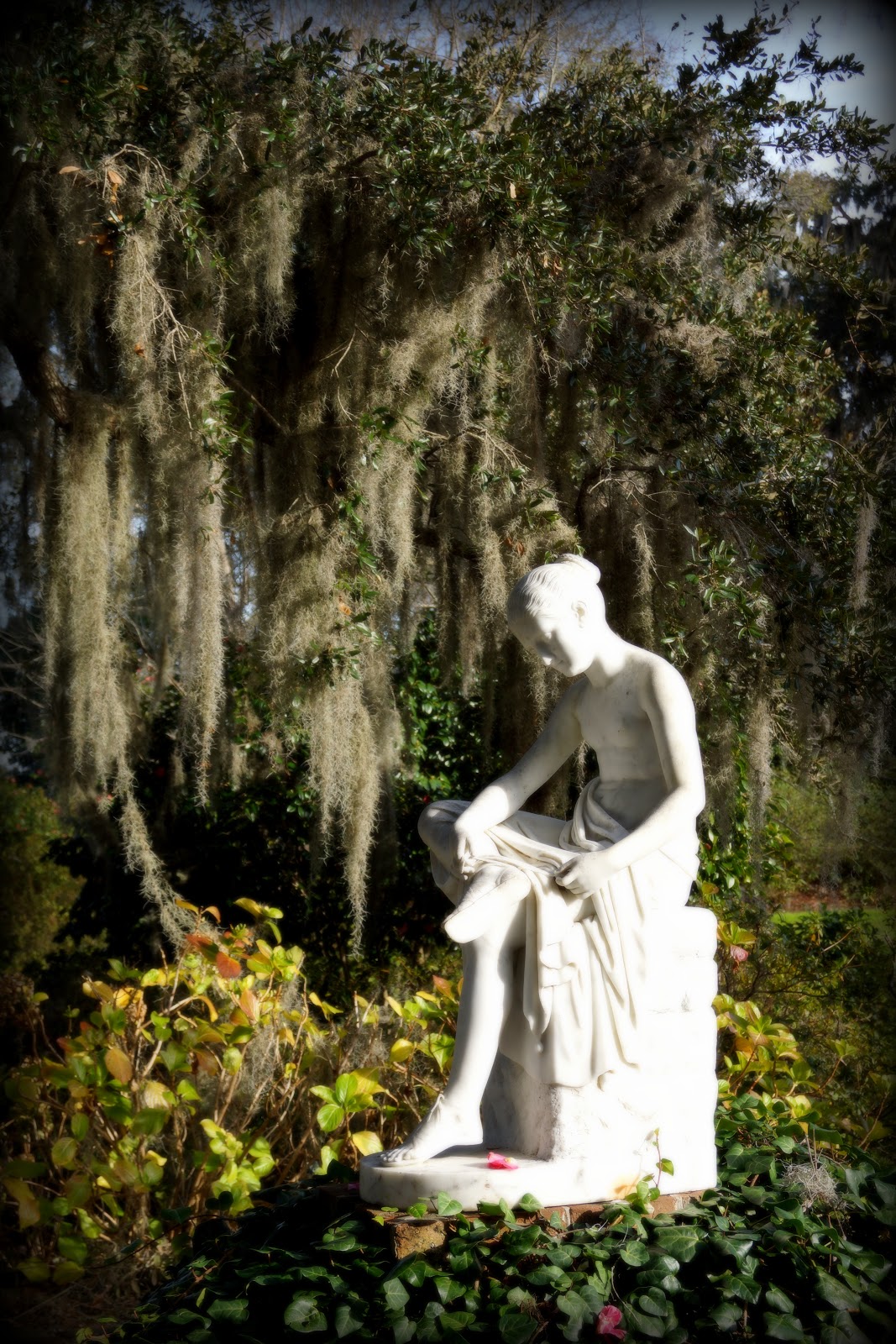
You may (or may not) have noticed that the pictures in this blog are a little different from my usual photos.  The light on the day of our visit was very harsh, it being a clear, crisp midday visit. When I viewed the photos later I was unhappy with the results. There was just too much bright, hard space around the edges of the pictures. 

Before:


After:


So I experimented with some special effects in Picasa and ended up treating almost all of them with the shaded edging technique called "vignette" and another effect called "soften." The results may look a little Hallmarkish to some, but it felt more appropriate to the humid, historical and romantic feeling of the scenes, and the whole plantation milieu.


This statue, the "Wood Nymph" by Rudolf Schadow typifies the Romantic influence represented in the 19th century expansions of the gardens. The original pre-Revolutionary gardens are the oldest landscaped gardens in the USA.


In contrast with the formal character of much of the older gardens, my favorite details were the natural combinations of large, shiny magnolia leaves hung with spanish moss.


The visit gave us a feeling for these older plantations, that were built on slave labor, and essentially destroyed after the Civil War. The life was not as glamorous as Gone With the Wind, but was certainly larger (and much harder for some) than the life we live now.  Middleton, and the Charleston area is so deeply steeped with history compared to most the western USA, where we've been traveling for the past year and a half.  Tomorrow we go to Brookgreen Gardens, built on the remains of another plantation, up near Myrtle Beach.


Sunday, December 23, 2012

Happy Holidays from South Carolina


We're in Mount Pleasant, SC for the month, visiting with Rick's family. Our days are filled with wrapping presents, baking cookies, taking new walks, eating out with different combinations of family members, and getting some essential self-care taken care of (dentist, haircuts, Kona grooming). Rick has a wonderful family and we always have a good time visiting.

I've been baking almost every day. It's fun to have a lot of people around for the holidays so I can make lots of different kinds of cookies and not have to eat them myself. I started with a favorite of my son Mark's, pecan puffs from the Joy of Cooking. Then successfully tackled one of Rick's grandmother's old recipe's for white sugar cut-out cookies. I'm also trying several batches of savory cookies for grown-ups: blue cheese pecan icebox crackers, cheddar cheese cranberry pecan crisps, "tango" lemon cayenne cookies, and basil cookies. So far so good!

Looking forward to Christmas Eve and Christmas day with the whole local family. The youngest is Caroline, who is the star of every gathering, as anyone who knows 1 1/2 yr. olds understands.  It's her first real Christmas, and she is enamored with and excited by all of it.

I remember it well, and it makes me miss my son Mark, who is now grown up and living in Boston.


Rick and I send our best wishes to all our readers, with hopes for beautiful, loved filled holiday celebrations, and a joyful New Year.