"Could I have this dance for the rest of my life?" - Anne Murray

Thursday, January 17, 2013

Marvelous Places: Edisto Island

... and a little odd at times. Out of the ordinary at least. Perhaps it was just our luck for a few days, but Edisto Island presented itself as unusual. Maybe it was getting away from commercial development again that allowed the natural world to emerge this way. Whatever the reason, here it is.

Edisto is one of the least developed sea islands in South Carolina. Two large portions of the island have been preserved by the Edisto Beach State Park and Botany Bay Plantation. The town of Edisto Beach populates a strip between the ocean and the Edisto River and salt marshes. The homes are a mix of modest and grand, but not the high end ones like you might find on Hilton Head, which is not too far from here.  Here's Rick's favorite.


There are a few restaurants and one small Piggly Wiggly and an True Value Hardware, a couple of gas stations.  During the winter it scales way back, which suited us just fine. As we rode our bikes around town, I liked it enough to fantasize about living here, at least in the winter time.

We stayed in the State Park for three nights in site 74, with 30 amps, no sewer, and 95 feet backed up to the salt marsh and a short walk to the ocean. Our site is kind of muddy, but that only allowed us to see the evidence of what must be an army of raccoons using the puddles as wash basins.


We've seen more raccoon tracks on their well-beaten paths elsewhere in the park too, but haven't seen any in person.

The weather has been perfect for getting out on the beach, and we don't have to drive anywhere for a great walk. This has made Kona and Rick very happy.


 Edisto beach is known for its shells. We've seen lots of oyster shells, and a few whelks, usually partial, like this one.


We've caught colorful sunrises and sunsets on the beach.


And an evening rainbow-sunset combination! 


We saw this rainbow out our back window over the marsh, and then dashed over the dunes to the ocean to see the other end there!


The sillouhettes of the palms always make for a nice sunset shot.


We spent much of yesterday at Botany Bay, where we saw some of the most unusual scenery since we've left the west.  


                     Botany Bay Rd. exemplifies the lushness of the landscape around the island.


Admission is free, and a self-guided driving tour takes you through the Heritage Preserve/Wildlife Management Area (Botany Bay for short). It was created from two old plantations, the remnants of which are still visible in the roads, fields, and a few buildings, ponds and dikes.  

In Picnic Pond, we had the good fortune to see a large alligator brumating amongst the duckweed.  (OK, I'm showing off.)


This is the ice house, one of the only structures left from the Bleak Hall Plantation.


Another small structure, the gardeners shed, is partly in ruins, exposing the "tabby" of which is it constructed. This was a new one for us. Tabby is an old and very labor intensive form of concrete, with a high percentage of oyster shell. Here you can see just how much shell they used.


Visitors are welcome to leave their cars and walk around the Preserve, among the various ruins and natural features. While heading back to our car, we spotted this big guy hanging out on the gate.


The highlight of the visit to Botany Bay though, was the beach.


It's a very unusual one, with dead trees in the surf, exposed by erosion.


In some places I felt like I had stepped into Ingmar Bergman's The Seventh Seal.


To top off our tour of unusual places, we passed the Mystery Tree on our way back to the park. It sits in the middle of a marsh, and no one knows who decorates it, but it changes with the seasons. It's decorated for Valentines Day now.


We leave Edisto tomorrow, and will stop in Woodbine, GA for the weekend, some Patriots football, and more unusual adventures. 

Tuesday, January 15, 2013

It's in the Details: Edisto Beach State Park

When the beach is a washed out expanse of hazy light, revealing only subtle changes in hue from earth to sky, I can sometimes find something interesting down at my feet.


Next, a bigger view of Edisto...


Historic Charleston, SC


 Several times since we arrived here almost a month ago, we've taken the 20 minute drive into Charleston to see a little more each time of this beautiful city. Charleston has recently been selected by Conde Nast as the top tourist location in the USA and the top city in the world!  It has a rich history that is evident at almost every turn, except maybe this one:


This is the new Ravenel Bridge that links Mt. Pleasant and Charleston, so we have to cross it every time we go into the city (no tolls!). It's an inspiring bridge and we can see it from much of Mt. Pleasant.  At the peak of the bridge you get an expansive view of the Cooper River, Charleston harbor, the USS Yorktown, and Ft. Sumter, the site of the first shots of the Civil War. 

On our first trip into the city we wanted to see the famously beautiful ceiling of the Unitarian Church.  There are some exquisite pictures if it and others at a website called Churches of America, which I'd highly recommend even if you aren't into churches. We had read online that the church was open every Friday and Saturday for a few hours. 

 So one Friday we found our way there, found parking (which is not easy in Charleston) and found that the church was not open on Fridays after all.  Well, we enjoyed the outside instead, along with the Lutheran Church next door.


It was a beautiful day, as you can see, so we wandered around a bit practicing our architectural photography. We've been photographing nature scenes for so long; buildings are really different. Because Charleston is an old city, the streets are narrow, and it's hard to get very far away from your subject. Some of these close angles worked out well against the clear blue sky. 

The typical Charleston home is called a "single," with a single row of rooms on two or three floors. The homes were built this way to maximize cross ventilation in each room. They often have the narrow side facing the street, and many have porches built on the wide side, making them look like they're sitting sideways. 


For Christmas, my son Mark and his girlfriend Ahna gave us tickets to a History and Homes Tour with the Old Charleston Tours company. So a few days ago we drove back over the Ravenel Bridge, lucked out with a free parking spot on the street and met our tour guide in Washington Park on Broad St.  She was very knowledgable about the history of the city, even more so because she grew up here.  She has lots of fun anecdotes about how much the city has changed just in her lifetime. 

The day was not so beautiful; it was overcast with a pale grey sky.  I know that some photographers really like overcast skies, but I haven't got the hang of it. Photos on these overcast days always look kind of pale or dingy to me. Anyway, we started at the "Four Corners of the Law" (Broad and Meeting St.) where each corner has a building representing a branch of law (church, county, city and federal).  In this picture a woman is selling sweet grass baskets in front of what I think is the federal building. 


The tour walked us through one of the oldest residential areas of the city, with classic Charleston homes, churches and commercial buildings. The photo below shows the wrought iron work that Charleston is known for, much of it, like this example, is over 200 years old.


The "War Between the States," or what Northerners call the Civil War, was very hard on Charleston, and many buildings were damaged or destroyed. Then, as Charleston was well on its way to recovery, the big earthquake of 1886 devastated much of the city once again. Many of the old buildings have these braces running through them, with caps like those below visible on the outside.  Sometimes they just look like architectural details, with lion's heads and the like. 


These periods of destruction (most recently topped by the damage done by Hurricane Hugo) have had a  dramatic impact on the architecture in Charleston. Each event gave the town the opportunity to reinvent itself, but it never losses sight of its heritage. Our guide told a a joke: What do Charlestonian's and Asians have in common? They both eat rice and they both worship their ancestors. (I hope that's not an offensive joke - none intended) We have certainly seen a lot of historical portraits in these old homes, and heard a lot about rice agriculture.

This house is a large single with a porch that was probably added on later. Our guide told us that the singles did not originally have porches. Why not??  Tours in horse drawn carriages are also a popular tradition here.


We finished our tour at the Edmondston-Alston House. It is a home that has been preserved and filled with antiques, 90% of which have belonged to the Edmundston or Alston families.  One of the Alston's still lives on the third floor.


We couldn't take any photos inside, but we could take them on and from the porch.  The front of the house has wrought iron trim, and provides a view of the Battery - the road that runs along the harbor.


We got a birds eye view of their garden.


On another day in the city I saw what I think was a carriage house, or maybe a gate house, that is now part of the College of Charleston.  A lot of the buildings in Charleston are pink. 


Back out in Mount Pleasant, we intended to visit Boone Hall, but it was closed for the month. Luckily, right across the street was the Charles Pinckney National Historic Site, so we got a little outing anyway.  The only remaining structure on the site in this idyllic southern home, what we would call a "cape." Is that the right name here in the south?


Many of these plantations and homes have joggling boards, which I loved bouncing on. The story is that they were based on a design from Scotland, built to provide a little bit of movement for a woman incapacitated with arthritis. I imagine they probably got more use by children.


Speaking of children, grandniece Caroline thought the Angel Oak was the best playground ever.


We thought it was pretty grand too. It is said to be as much as 1500 years old.


Today we leave Mount Pleasant, with loving family memories, a greater understanding of why Charleston is such a popular destination, and an appetite for shrimp and grits well satisfied. We're sad to say goodbye to our family here. It's been so long since we've been near family and it began to feel like home. Maybe someday it will be. Who knows?

Next stop: Edisto Beach State Park.

Sunday, January 13, 2013

Fog Bow on Isle of Palms, SC

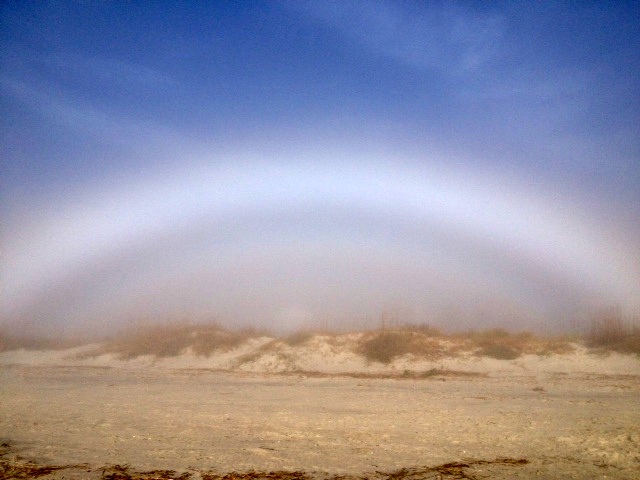
Look what Rick, brother Bob, friend Cathy and I saw today as we walked the beach on Isle of Palms! 


Thank you Cathy for catching this on your iPhone! It's called a fog bow and is just like a rainbow, except that because the particles are so uniformly small they make a white bow rather than colored. It, like others of its kind, does have a little pink and blue in it. They are relatively rare, but happen more often near or on the ocean, and in the Arctic. 

Saturday, January 12, 2013

Mount Pleasant KOA

While here in Mount Pleasant, SC, we're staying at the KOA. Although KOA's are not our favorite spots, we chose this one because it's close to family and Charleston, and we've been happy with it. KOA's are often pricey, overburdened with rules, and one pays for lots of amenities and activities that are aimed at families with children.  This one is very relaxed and reasonable for the monthly rate of $508, which includes taxes and electricity.  It is located on the Oakland Plantation, a very large historic tract of land that still has the original home, which you can see on a biweekly wagon ride.  What I like best about this KOA is the long nature trail along through the undeveloped parts of the property. Kona and I walk it often. I thought I'd share some pictures of a quiet day at the KOA.


 An early start around the trail resulted in some nice hazy morning scenes. The live oaks, Spanish moss and palms create the typical Southern silhouettes.


The path through the property follows several long ditches that seem to be effected by the tides. Signs at the start of the trail warn walkers to stay on the trail due to alligators and poisonous snakes! I haven't seen any, but it's winter.


Many egrets and herons live along the ditches and are always startled by our walking by. The herons make a really loud squawk that has startled me more than once, even though I've come to expect it.


Here you can just see one sitting up in the bare branches to the right of the palm.


The path also goes through a couple of areas with smaller low hanging trees, lots of vines and palmetto undergrowth.


It was still early enough that I caught the light on some dewey spider webs...


twigs...


and this fascinating unidentified plant.  It was the only one like it - about a foot tall, with purple and dark green foliage. 


The path ends with a stretch along the fresh water lake.


Back at the campground, here's our site, #29. Nothing special really.


Next to the office there's a swimming pool covered with a bubble. We haven't tried it out. 


Today I'm alone in the RV while Rick helps the family out with some furniture moving. I'm baking bread, doing laundry and writing this post. 


A few times this month we've had some nice sunsets over the lake.  Is this the life or what? Tonight however we won't be here. We'll be at Carolina's Restaurant in Charleston, celebrating Rick's brother Bob's birthday. We leave in a few days, but I still hope to write a post or two about the things we've been doing and seeing here. We'll see...