"Could I have this dance for the rest of my life?" - Anne Murray

Saturday, October 5, 2013

Historical Philadelphia and Winterthur, Delaware


For a little less than a week we stayed in West Chester, PA at a very nice KOA. While in the area we visited Longwood Gardens (see previous two posts), downtown Philadelphia, and the Winterthur Museum, Garden and Library in nearby Delaware.

The area, called the Brandywine Valley is known for its historical richness, and this was evident on every back road.  Small, two story stone homes (some of them plastered and painted white) accompanied at times by huge stone barns are nestled in valleys, along the rivers, in little towns and on the rolling hills. I wanted to take many pictures, but there were rarely any shoulders on the roads to pull off safely, and all the locals are going about their 21st century business at breakneck speeds.  This is, after all, a commuter suburb of Philadelphia and Wilmington, DE.

I was able to take pictures of one home that is typical of the area - the John Chad house, after whom the town of Chadds Ford was named. John Chad had a ferry that crossed the Brandywine.


 The stone is called blue stone according to the information on site, even though it is all different colors.


This barn was on a side road where I could safely pull off for a second. It was a real beauty. Notice the slits in the stone walls for ventilation.


We also spent a day in Philadelphia to basically see Independence Square. Parking was a hassle, as was finding our way around. We bought our tickets for the tour, had an uninspiring lunch somewhere and wandered around a bit.

I did like this view of a side street in the historic district.


Here's a view of Independence Hall.  We aren't wild about cities, so we were in an out pretty quickly. I'm sure we missed a lot of things that others would find interesting. Sorry Philadelphia.


In contrast, our visit to Winterthur was relaxed and inspiring. It was quieter than Longwood - fewer visitors, but the same kind of quality experience in every way. At the Visitors Center you get a tram that takes you on a long ride through the extensive arboretum and woodland gardens, then deposits you at the house/museum (below).  The house, once the residence of Henry Francis duPont and now a museum, is nine stories on the side you can see here, and four stories on the back. It is built into a hillside and surrounded by trees. Very low profile except for this view. Not particularly inspiring on the outside.


Henry duPont was a collector of antique American furniture, tools, and housewares of various sorts, and his home was completely furnished with them.  Each room of the house had a different style of furnishings. Below are a set of Paul Revere silver tankards in a room furnished in the same period as the tankards. 


Guests are led through the house in groups of ten, by a very informative guide.  Unlike similar places , guests are free to take pictures. I noticed that items (like silverware) that were sitting out on the furniture were strung with clear filament like fishing line - so fine you could barely see it. I suppose it was all hooked in to some kind of alarm system. There were times when the guide was way ahead of us, and it would be pretty easy for someone to pocket some silverware, so the security system must be effective.

This colonial era room was one of our favorites. 


This room had hand painted Chinese wallpaper from the 18th century.


An adjacent building is a more typical museum with other collections of American material culture including tools and primitive arts. 


This grand staircase is in the museum section.  Looks just like an eye from this angle, doesn't it?


Outside there are lovely gardens to wander through, but very low key compared to Longwood.  There was also an interesting gift shop and a excellent small cafe.  


Oh, I almost forgot the Campbell's soup tureen collection. We found it odd.  

Next stop, Fallingwater!

Thursday, September 26, 2013

Longwood Gardens Part Two: The Conservatory

(This post is especially for Caroline and Catherine. Wish you were here.)

Well, I promised to reveal the four coolest things I had ever seen in a garden and/or conservatory, and I will. But now there are five. We went back again yesterday and found another way cool thing in the Conservatory that must be included. Hence the small delay in posting. 

Here once again is what the Conservatory looks like from one end... 


...to the other.


Inside there are many rooms, large and small, with different kinds of tropical and desert displays.  There are also outdoor sections, or courtyards within the structure. 


I was especially impressed with the perfect and unusual plant pairings. Here are two of my favorites.


OK, on to the most cool things ever, in no particular order.  First the "Green Wall."  This may look like a bank of elevators, but they are individual, domed, sky-lighted restrooms. The wall is completely covered in different kinds of ferns. It is the largest green wall in North America, and I'll bet its the healthiest.  The plants are just dripping off the walls. 


The experience of walking into this space is complete science fiction. 

Here is a tiny section that was being replaced, to give you a sense of how it's done. Individual plugs are planted into a steel framework of some magical growing medium. The link above will also take you to an article about the Green Wall, with all the facts and figures.


Cool thing #2. The Longwood Organ, housed in a grand ballroom within the Conservatory. Another complete surprise as you are wandering around immersed in plantness, and you stumble onto this!


Behind the ballroom is a hallway with huge windows looking onto all the organ pipes, 
which range from itty bitty 1/4 inch diameter metal pipes...


...to humongous wooden rectangular columns.


The pipes are separated from the ballroom by a fabric wall that vibrates in different ways as the organ is played, depending on which pipes are "blowing." The organ is played electronically several times a day in addition to scheduled live concerts and big deal organ competitions. 

Now, the coolest thing #3, floating in one of the Conservatory courtyards: 


As you can see, Victoria water lilies are immense compared to your regular run-of-the-mill water lilies floating nearby. They are different in other ways too. They have these edges that uncurl and then stand up as the pad develops, and the bottoms and sides are spiked with thorns to keep them from begin eaten. 

You can see in these pictures how they come in different colors, depending on the variety.


In the picture above, a blossom bud is just starting to open. The blossoms are always white the first night they bloom, then they close up (with little pollinating beetles trapped inside!) and open the next night, having changed to pink. (The beetles get to fly away.) Then that's the end of that blossom's short showy life.


This guy is the Victoria caretaker. We saw him there twice, wading around, pruning out the dead flowers and pads, and sharing fun facts.


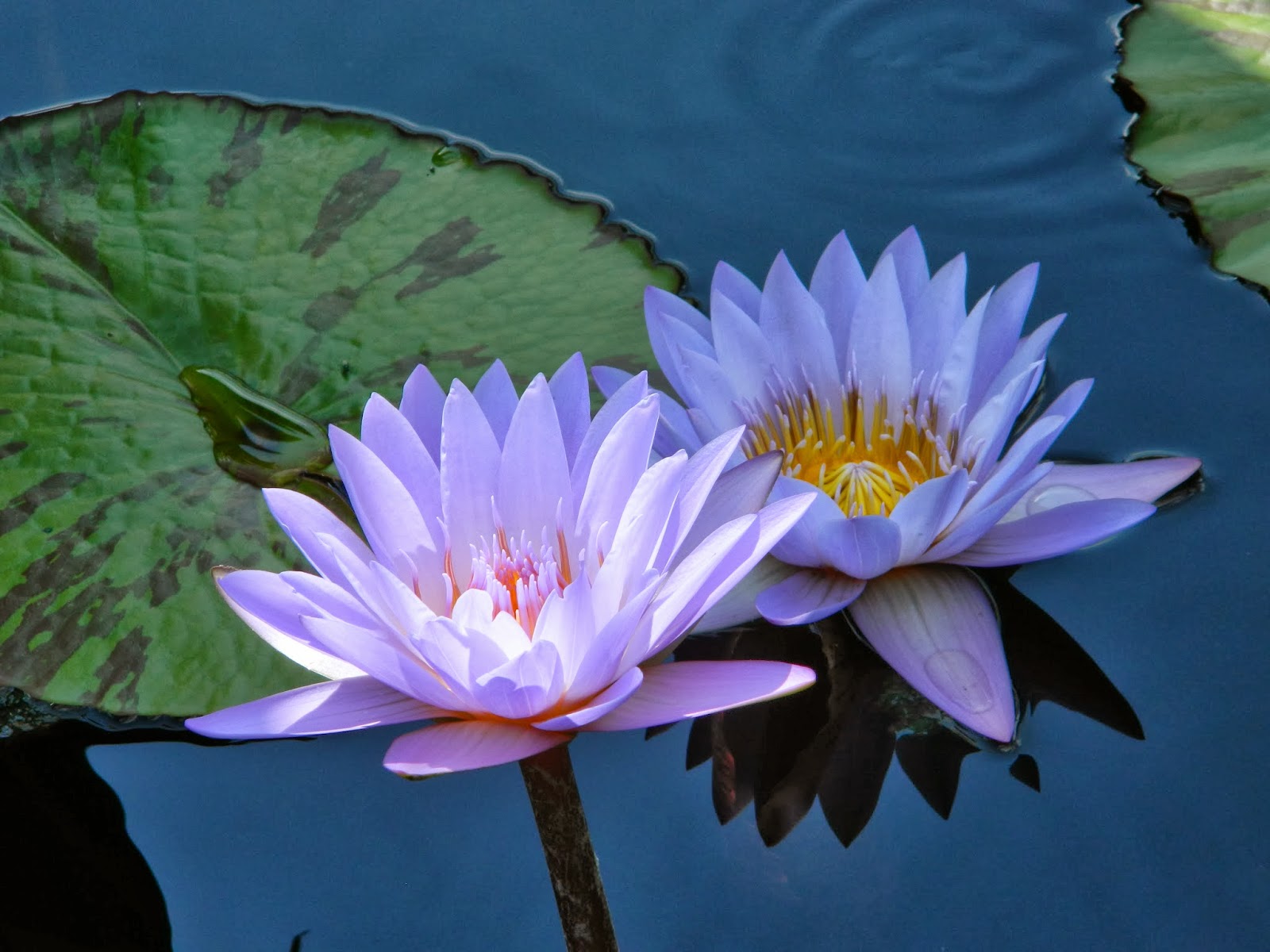
The ponds in this courtyard hold several varieties of Victoria lilies as well as more standard kinds of water lilies, often mixed together.  Here are a few pictures of the regular lilies - just as beautiful if not as exotic.


OK, hang in there for the 4th cool thing.  The Orchid House. We've seen a lot of orchid displays, as I'm sure you have. But this one was so huge, and so varied, that it positively possessed me. (Oh, and the smell was glorious.) I had to go back a second day to take more pictures. Here are just a few of the more successful ones out of the gazillions I took.


And finally, the fifth cool thing that I had to add as a result of our visit yesterday: the Indoor Children's Garden. Oh boy. My inner child's dream come true. 


It was a miracle of mazes, grottoes, tunnels, spiral staircases, fountains, statues, archways, windows, balconies - all the architectural details that children love. Oh and a few plants too.


There were secret little details to discover everywhere, just at childs-eye level.


There was water to play in and with at every turn. 
Finally! Fountains the kids can just stick their body parts into! 


This was a little row of bubblers that a kid, like Rick, 
could run his hands through as he ran up and down the little ramped passage it was in.


This low arched walkway was lined with mosaics made of beautiful shells, 
again, right where you could touch them.


Fountains everywhere, of every imaginable shape and size, doing all kinds of tricks: ringing bells, overflowing, bubbling, jumping, streaming, spraying. 


This mini-grotto had the smoky dry ice effect. Above it were hanging black stalactites with a snake coiled through them. This was the darkest place in the garden. 


In my opinion this children's garden had just the right balance of scary and wondrous. Or maybe it was tilted a little to the scary side. It certainly wasn't all sweetness, light, talking animals, fairies and unicorns.  It had some tooth!


There was even a child sized mini-chapel with kid friendly chairs and stained glass window. 
(Perhaps it was intended as a safe place to hide or calm down.)


What a perfect place this whole conservatory would be for a family on a cold rainy winter day. It was a perfect day (or two) for me.  Next I hope to write a post about Winterthur, another local favorite, before we start heading west again. Tomorrow we go for some repairs to our hydraulic system, and a day visit to Lancaster, PA. 


Tuesday, September 24, 2013

Longwood Gardens: Part One

One of the main reasons we came to the Brandywine Valley was to see these gardens, and they did not disappoint.  Like the Butchart Gardens, the place is so immense that I am going to need more than one post just to show you the highlights.


Longwood Gardens was originally the home and estate of two Quaker brothers, the Pierces, who planted a vast arboretum. At some point they were unable to keep the land and the trees were in danger of being cut. Pierre duPont bought the property, saved the trees and continued growing the arboretum and gardens around the homestead. Pierre duPont (of the duPont chemicals family) was clearly an exceptional man, with oodles of money, and something of a Renaissance man as well.  Over the years the Gardens have expanded to include the largest conservatory (greenhouse) I have ever seen, a children's garden, acres of fountains, a topiary, three home sized tree houses, immense formal flower gardens, and more.


Outside of the visitor's center were spectacular Fall annual plantings, and it took us a long time to get past those before we even got inside.  All the plants throughout the gardens look unbelievably healthy and lush. 


Once into the Visitor's Center and after seeing the short history film about Longwood, we were advised to head toward the Open Air Theater, which is a large fountain display accompanied by John Phillip Sousa music. While it's not the Bellagio, it is entertaining. A little variety in the music would make it even better. 


Pierre was really into fountains, and I believe he did much if not all the designing and engineering himself. Quite a feat considering that most of them are changing displays of heights, intensities and colored lights. 


Along the Flower Garden Walk, the colors of the perenial blossoms are arranged in a long rainbow sequence, starting with purples and very gradually moving to reds, oranges, yellows and finally whites.  Although this means that each area was basically monochromatic, there was an artful variety of sizes, shapes, textures and foliage so that the design was very effective. These were in the pink to red section.


There are three super-sized tree houses in the gardens. 
This is the Canopy Cathedral Treehouse. It looks very Nordic inside and out. 


This one is called the Birdhouse Treehouse.


Where the tree houses are relatively"tiny," the Conservatory is Worlds Fair-sized. In fact, duPont was inspired by the Worlds Fairs he attended.  This view shows only about half of the building.


I can't even begin to describe all that is in there, but I'll take a stab at it in the next post.  Let me just say that we spent a very long time in there and saw the four coolest things I have ever seen in a garden. 

But, jumping ahead, after the Conservatory we were pretty overstimulated and just headed in the general direction of the exit, missing the Idea/Trial Garden, the Children's Corner, the Hillside Garden, the Eye of Water and the Oak and Conifer Knoll. Well, we need something new to see when we come back. But we did see the Garden Railway and it was very fun.


We staggered around yet another multiplex fountain thing...


...and finally through the Topiary Garden, (viewed here from the small but fragrant Rose Garden) which I'm really glad we saw.


So, tomorrow I'll tell you about the four coolest things ever. Can't wait?