"Could I have this dance for the rest of my life?" - Anne Murray

Sunday, October 14, 2012

Chama, NM: Cumbres and Toltec Scenic Railroad

As I've mentioned, there isn't a whole lot going on in Chama other than the Cumbres and Toltec Scenic Railroad, which runs between that town and Antonito, CO.  Before we got here we had been told that it was well worth the time and money, so on our last day in Chama, we took a full day ride.

We arrived at the historical station in Chama at 9:45 and walked around the railroad yard before were  allowed onto the train.


There are lots of antique train cars in the yard, some look like they haven't been used for a very long time.  Our train was about eight cars long, with an open air car in the middle, accessible to all the passengers. 


After reading the reviews online, we decided to splurge and go first class. (It's a lot more affordable than first class on an airplane!)  We had very comfortable chairs facing the windows, with a little ledge on which to put our refreshments and other things.


We had a very nice hostess who served us a breakfast of fruit, pastries and beverages, and shared interesting information with us as we travelled.  Notice the beautifully restored details of our car. The roof is pressed tin, the woodwork was beautiful cherry and there were several large hanging gas lamps  and sconces.


The first class car is last one on the train because the smell of the smoke, the dust and cinders are supposedly less.  We were able to stand out on the back platform whenever we wanted and the air was usually clean and fresh.  It was a comfortably warm, sunny day, so I for one was out there a lot. It was a perfect place to take pictures.  The train's fireman was also out there most of the time, keeping an eye out for fires that might be started by the sparks from the locomotive.  


The train is pulled by an authentic coal-fired steam engine. That means lots of coal smoke, ash and tiny cinders being spewed all the time, especially when going uphill.  The coal is shoveled into the stove, just like it was originally.


The two plumes of smoke coming from the engine are steam (white) and coal smoke (black).  The train is followed by a fire car that also looks for fires, and is equipped to put them out. 


The train runs on narrow gauge rails, which means there is less space between the two rails. This is kind of train is rare, and so is of great interest to train buffs.  The train travels at a maximum of 22mph, and often travels slower when going up inclines.  At first it seems unbearably slow, but you get used to it.


The other cars are similar to ours, some with small tables, some with bench seats.  I think any of them would have been comfortable and some people might actually prefer the bench seats. 


The cars have no heat and no air conditioning, but all the windows can be opened wide.  Some of the passengers we talked to had ridden this train in October when there was a blizzard and they didn't get back to the station until after midnight. Another time the engine tipped right off the rails while trying to get through the snow. I guess we were fortunate with the weather. 


The train climbs uphill most of the way out of Chama, passing water towers like this one, making wide looping turns to get up the elevation, and going over various trestle bridges.  Because the engine runs on steam, it must have a supply of water to be heated by the coal. So the towers are interspersed along the route in case the tank needs a refill.


The scenery was great, especially in the first half of the trip up to Osier, where we had lunch.  The lunch was a buffet, with the choice of meatloaf, turkey, or soup and salad. It was all very good, especially the coconut custard pie  : )


 In this picture you may be able to see some muddy smudges on the upper window panes. Those are bear prints. It seems that the local bears try to get in to the food through the windows.  I assume they are now some kind of strong plexiglass, because the weight of a bear would certainly break glass windows.

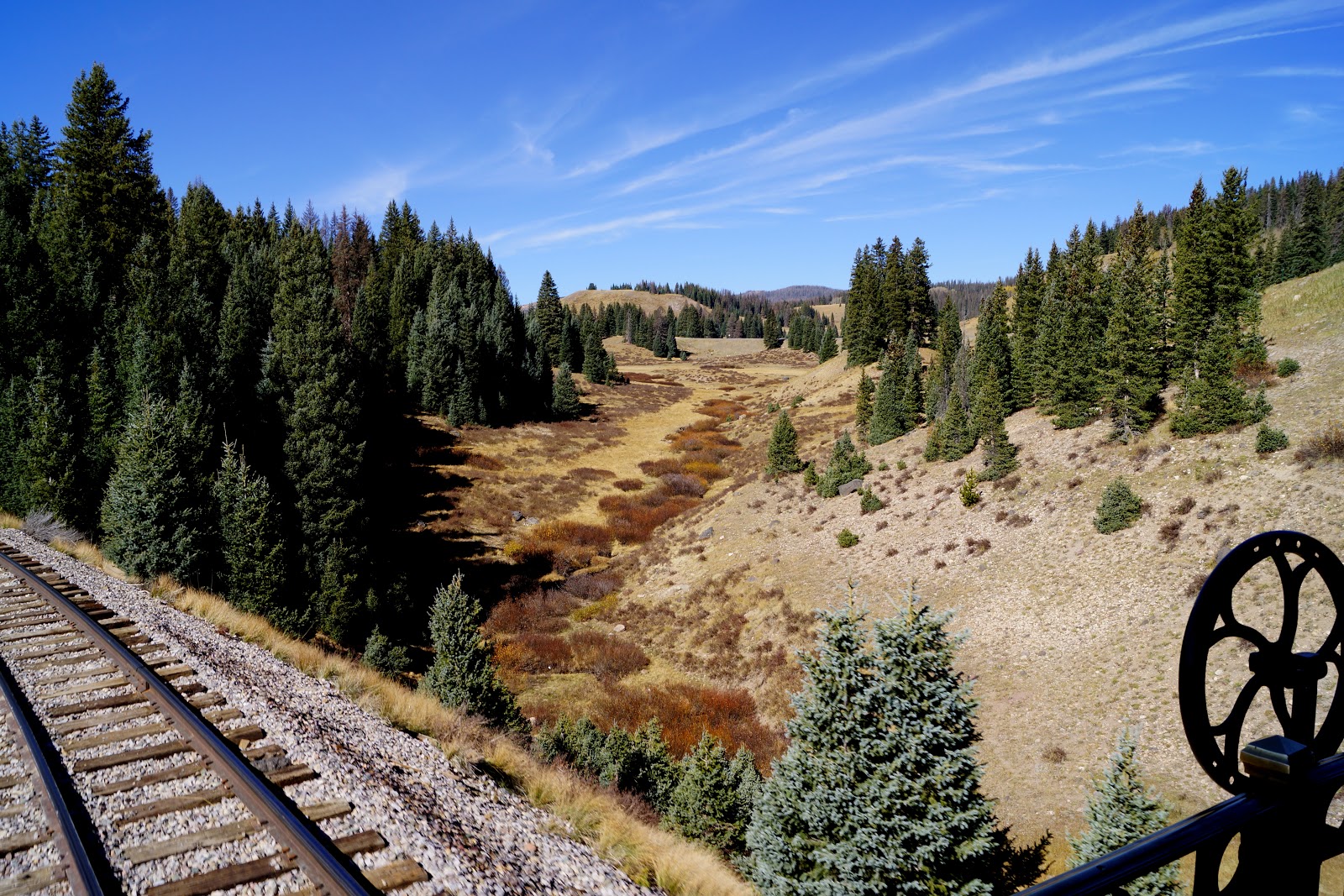
Here's a nice view of a high mountain valley from the back platform. The round wheel you can see in this picture is the break wheel. When going down hill, the fireman on the back puts on the break to keep the train from going too fast or descending out of control.


Here's the Cascade Trestle Bridge - the highest on the route.


This is the Cascade Creek, I think. 


On the second half of the trip the train passes through two tunnels. The first is the Rock Tunnel.


The second tunnel is the Mud Tunnel, and because it passes through mud, it is braced, unlike the Rock Tunnel.


We were fortunate to pass through many areas of peak aspen color.


When we reached the end of the line in Antonito, we said goodbye to the train... 


...and loaded into a modern motor coach for the ride back to Chama, at 60 mph.

Next, the Balloon Fiesta in Albuquerque!

Monday, October 8, 2012

Taos, New Mexico


A long time ago, when I was maybe 10 years old, my parents and I travelled to Taos, NM so my father could receive their recognition and thanks for doing some work for the Pueblo.  They were in the midst of a struggle to maintain control and exclusive access to Blue Lake, a sacred place for their people. My father had supported their case, probably with an amicus brief and as an expert witness, in either the state or the federal courts, justifying the Pueblo's claim as a right to religious freedom.  I don't remember all the details, but I do remember the unique feel of being there and the honor I felt on behalf of my father. We may have been there at a time when there were some ceremonial dances. The chief at the time gave my father a gift of a basket made at the pueblo, and I still have it hanging in our RV. So it was pretty special to be back there again.  I do believe they may have won their case, at least in part, as the land around Blue Lake is now off limits to anyone but the tribe.


The Taos Pueblo is distinct from the town of Taos, which is a touristy, hectic kind of place, with traffic jams and not enough parking. The Pueblo is very quiet. It is recognized as the longest continuously inhabited community in the country, and the present buildings (excluding the church) are estimated at 1000 years old.  

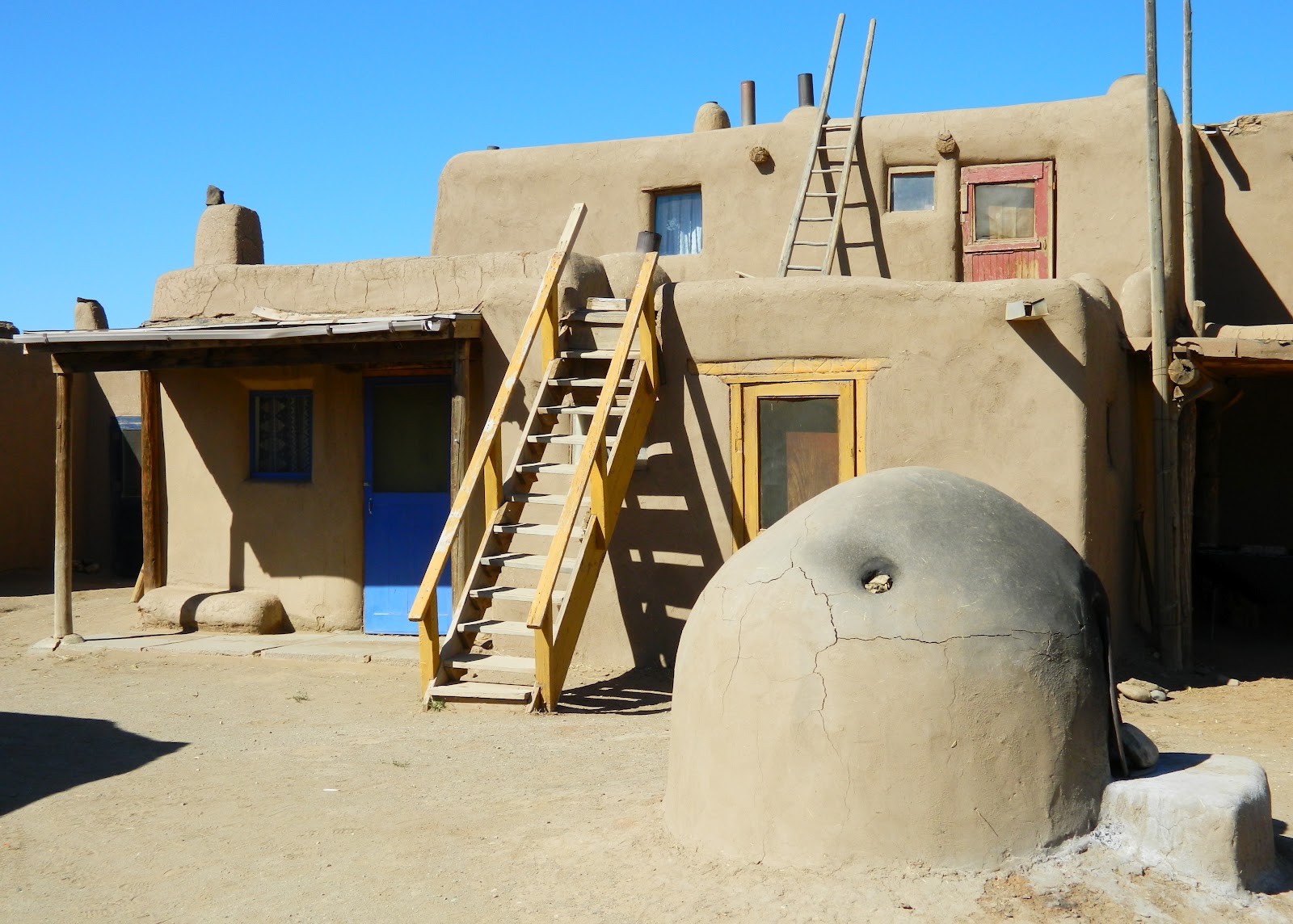
The buildings are all made of adobe, a mixture of earth and straw. The adobe is refurbished every year. 


The pueblo is comprised of two major residential structures with a few smaller ones clustered nearby, two ceremonial areas with several kivas each, the mission church, a few corrals, and a cemetery. There is a stream running through the middle, which is their only water source. There is no electricity or plumbing in the buildings.  The residential structures have many family homes, like apartments, that are all separate but with shared walls, and originally the only entrance to each home was through the roof. Doors were added in more recent times and are often brightly painted in contrast to the monochromatic adobe.  The round structure in the photo below is an oven where bread is baked.


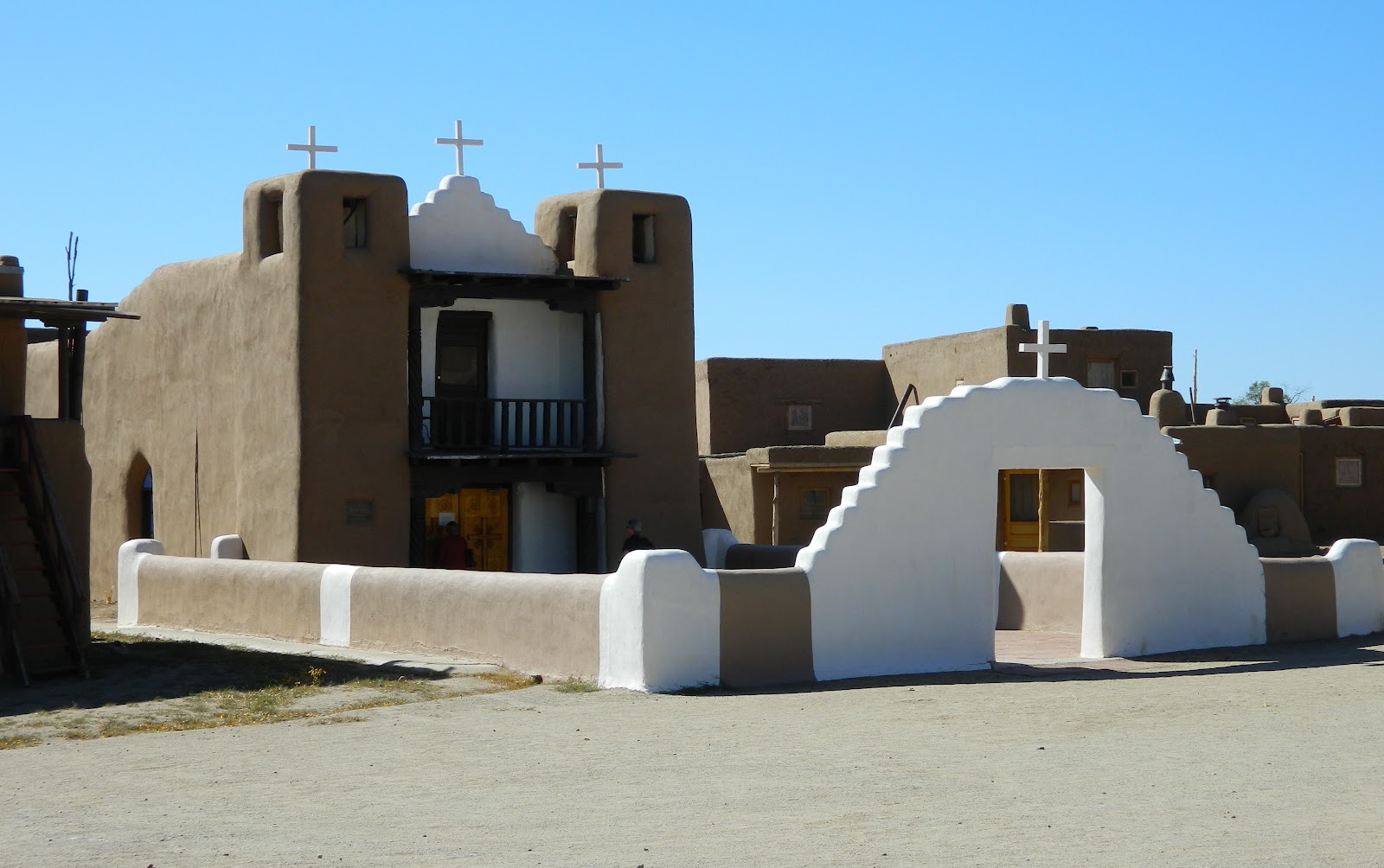
The original San Geronimo (St. Jerome) church was built by Catholic missionaries in 1619 then destroyed twice in revolts or altercations (and interesting history worth reading about) and rebuilt in its current location in 1850.  That pole you can see through the gate below is not a telephone pole, it is a ceremonial pole for some ritual purpose.  I don't think I saw any telephone poles.


The San Geronimo church is quite beautiful inside, with artistic references to both Catholic figures and Native American culture. (No photography allowed.)


The original church, in ruins, is now a cemetery.


The Tiwa people who built and reside in the pueblo practice a blend of Catholicism and their traditional beliefs. Almost all their names are Spanish as a result of the missionary influences over the centuries.  Along with the church and the Catholic cemetery there are traditional kivas in the Pueblo - round, below ground-level ceremonial structures, that are off limits to visitors (below). The Tiwa keep their sacred beliefs and rituals very private.


Ristras, or strings of dried chilies hang from the supporting beams throughout the Pueblo.  


Ladders are still used to access the different levels of the Pueblo buildings.


 On my way out of Taos on Rt. 64 I stopped at a roadside market selling ristras of Hatch chilies.  Hatch is a town in NM where these particular kinds of chilies are grown. This actually turned out to be a Mexican import store with thousands and thousands of inexpensive ceramic pots, blankets, jewelry, ironwork, tiles, and more, all from Mexico.


The road back to Chama crossed over the Rio Grande Gorge. I had no idea there even was a Rio Grande Gorge, so this was a complete surprise. And it is really grande - 650 deep at the point where the Rt. 64 bridge crosses it.  Looking down, those of us on the bridge watched five big horn sheep traverse the sides of the gorge, eating as they went.


And another surprise!  The Earthship Community!  The visitor's center is right on Rt. 64, west of Taos and the residential community is spread among the hills adjacent to the visitor's center.


There seems to be a lot of building going on, but not on Sunday when I was passing by. 


The sign says, "Warning! Official U.S.A. Sustainable Testing Site, 2.00 Acres"  ????   I don't even know if it was serious or a joke.  It could be a spoof on warning signs put up by the government around bombing sites.  Is the government funding this experiment? I guess it wouldn't surprise me if they had grants from the feds - sounds like something Obama would support.

"The Earthship" is actually the name of this kind of home, designed to be energy efficient in multiple ways. Their website is full of information about it. Turns out they are in other locations as well.  Looks like another planet doesn't it.  Star Wars?  These two homes are for sale.


So I had plenty to ponder about the comparison between the Earthships and the Taos Pueblo: innovative, alternative, high tech vs. traditional, alternative, low tech energy efficient communities.  How has the traditional influenced the contemporary?  Is there a future for either?

Refrain: Everything old is new again.

Chama, New Mexico

Now we're in Chama, a small town in northern New Mexico. There isn't a whole lot going on here except for the Cumbres & Toltec Scenic Railroad. We're planning a ride on that before we leave here.


Chama is high and dry, and it's fall here, with nights dropping below freezing. In fact, last night our hose froze because we forgot to check the overnight temperature. Luckily, Rick had to get up in the middle of the night to change over our propane tank and noticed that it was 25 degrees and there was no water running from our faucets. So he unhooked the frozen hose and stuffed it in the basement to thaw. (No damage done to the hose.) By about 8:30 in the morning it was warm enough to hook up the hose temporarily, fill up our water tank and put the hose back in the basement to stay warm. We don't have any trouble with our pipes or tanks freezing, but since the hose it outside it's exposed to the cold. 

Our first exploration of the week was up to Pagosa Springs, CO. We had passed through it on the way south and thought it looked interesting. The drive back up Route 84 was so pretty we didn't mind doing it again.


Guess what Pagosa Springs is famous for?  Yes, its springs.  There are a couple of resorts right on the San Juan River that runs down the center of the town.  Unlike any other resort I've seen, except maybe in the tropics, the whole place is visible to anyone walking along Main Street...


...and the river and natural hot springs are easily accessible as well. The springs are sulphuric, like those in Yellowstone, and have that subtle rotten egg smell, so it didn't draw us to soak.


After poking around on Main St. for awhile we dropped in to the Visitor's Center and the woman there suggested we take a short drive north on Rt. 160, up to Wolf Creek Pass. There's a popular overlook near the Continental Divide that gives you the view south toward Pagosa Springs.


Just a bit further along Rt. 160 there's a left turn on a dirt road that takes you up to the Lobo Overlook for a 360 degree view of Colorado and New Mexico.  Looking down from that summit you can see the Wolf Creek Ski Area.


From Chama it's about an hour south on Rt. 84 to Abiquiu, NM, noted for being an artists' community and the historical home of artist Georgia O'Keeffe.  There was a studio tour over the weekend so I thought I'd go check it out.  The route down follows the Rio Chama river, a major branch of the Rio Grande.  (Our campground, Sky Mountain RV Park is actually right on the river.)  Here it is flowing by  the landscape that inspired many of O'Keeffe's paintings.


The river helps Abiquiu be a green, fertile valley in contrast to the surrounding desert.


The old town is a typical New Mexican pueblo town with a dirt plaza surrounded by adobe houses. That area of the town is what might be called shabby chic in some parts of the country. In other words, it's pretty rundown. The town seems to be about half artists and half Native Americans or Mexicans.  There is at least one really upscale gallery in town: Jon Bosshard's Tribal and Traditional Arts. Contrary to what one might expect, it is not Native American Tribal or Traditional Arts; it all appears to be imports.  


The gallery is housed in one of the largest buildings in the plaza, and it has some nice architectural features, supplemented a bit here by nature. 


The mission style church in the plaza is one that O'Keeffe also painted. 


There were several open studios in the plaza, including the home of Napoleon Garcia, the local story-teller, town elder, guide, character and artist.  This YouTube clip is exactly what my experience was visiting with him, sampling his wife's delicious biscochitos, and listening to his stories.

My walk led me past the tiny public library, which was surrounded by this fence, a style that is often used in this part of New Mexico - tall thin tree trunks lashed together.


The rest of the studio tour was not all that inspiring, so I had a little lunch at the Abiquiu Inn on Rt. 84 and pondered what to do next.  After a very satisfying lemon bread pudding and a cup of green tea, I decided to travel on to Taos. Hope you'll check out my next post, as it has some really neat pictures of the pueblo there.

Friday, October 5, 2012

A Week in Southwest Colorado


For the past week we've been about 30 miles east of Dolores, Colorado, at the Priest Gulch RV Park. Dolores is a really small town, but it does have a few basic services.  We were in a beautiful area and the park itself is very nice, but because it's very far from any town, we had no cell service, and very unreliable internet. After a couple of days we moved to site 36, where we got satellite TV reception. Thank goodness, because it is football and The Voice season. : )


The trip from Moab to Priest Gulch shifted us into a vastly different geographic and climate zone.  It was probably the most dramatic change we've made in one day since we've stared full-timing. Moab was all red rocks and desert. This part of Colorado is a more temperate area of the mountains, with lots of water, evergreens and aspens. Moab felt like summer, maybe verging on late summer as we were leaving. But in southwest Colorado it was just past peak fall color season. The nights were below freezing and the days were cool, crisp and clear.  We had the heat on every night. This location is very close to the Rocky Mountains and we could already see snow on the peaks.

We didn't do as much sight seeing as we sometimes do, because we were pretty far from most everything. We did go to Mesa Verde National Park one day, and up to Telluride another.  Mesa Verde is just outside of the town of Cortez (where we also went for a real grocery store, hardware store, barber, etc.).  To get to the park you drive up onto the huge mesa, which was not green (verde), but was a rich tapestry of the golds, rusts and oranges of the Gambel shrub oak. 


There were spectacular overlooks from the top of the mesa looking northwest, but my camera couldn't really do the big views justice. The rocks here are not the red sandstone of Moab, but another layer of sandstone called Cliffhouse. I imagine it was named after the dwellings built by the Ancestral Pueblo people that are the reason for this national park.  


The dwellings date from about 500 to 1300 AD.  The earliest ones are small and are on the mesa top. The later structures were built in the alcoves of the cliffs and are what most people come to see.  There are over 4000 archeological sites in the park, though not all of them are dwellings, and only a small percentage of them are accessible to visitors. The Square Tower House, below, is the tallest of the cliff houses.  It looks to me as if it's at least four stories high.


The largest dwelling that we saw was the Cliff Palace. It is immense, even though in this picture it looks kind of miniature. It has 150 rooms and 23 kivas, the round rooms you can see near the front. It's estimated that about 100 people may have lived there.  We viewed it from above, but I think the best way to see any of these dwellings is by taking the ranger led tours. We had Kona with us, so we had to pass on that option.


Another day we drove north to Telluride, a ski area and town. It took us awhile to get there because we had to stop so often to take pictures. One of our stops was Trout Lake.


Another was at the base of this mountain; I think it might be Sneffels Mountain. (It's kind of hard to tell from the map which mountain is which.) It was a cloudy day but we got lucky and caught a little sun shining on its rocky peak.


Telluride itself is in a gorgeous river valley surrounded by snowcapped mountains and golden aspens. 


It was just a sleepy little mountain town until 1972 when the locals, encouraged by a recent influx of back to the earth hippie types and a few wealthy entrepreneurs, decided to change the image of the town, and a ski center phenomenon was born.  They were just about to start their 40 year Teluride reunion the weekend we were there, to celebrate the beginnings of this wildly successful place.  It's kind of like Park City, in that it still has its original cowboy feeling, but has developed a very trendy collection of galleries, boutiques and restaurants as well. We had a great lunch at the Brown Dog Brewery.


Telluride felt like a real town, with a lot of locals still living and working there - not just all for tourists. Above the town there is a massive seasonal residential area with grand houses, hotels and condos nicely tucked away in the woods so that they don't dominate the landscape. The architecture and craftsmanship of these places was very impressive, and now that I think of it, an interesting contrast to all the dwellings we saw at Mesa Verde. Certainly a different aesthetic, but each integrated into the environment in their own way. 


Other than a few local hikes and a trip into Cortez, that was about all that went on. It was a pleasant, quiet week in Colorado and now we're in Chama, New Mexico.  More on that next time.