"Could I have this dance for the rest of my life?" - Anne Murray

Friday, February 28, 2014

Things We Can't Do Without - 1

Today I thought I'd start a series of posts in which, over time, now and then, I'd share some of the things that we find so helpful, so often, that we consider them indispensable.

Three years ago, our decision to lead a full-time life in a 39 foot fifth-wheel trailer sent us on an anti-stuff campaign, starting with getting rid of everything we owned except what we could carry with us. When you live in 400 square feet, you have to be very selective about those things. There's no room for stuff that has no purpose. (In all honesty, I should do another series of posts about the things that we carry even though they have no purpose at all.)

Today we have the first of the maintenance and repair triumvirate: the yoga mat, cable ties and electrical tape.

Yoga mat

No particular brand is necessary, in fact the cheaper the better (try TJMaxx, Walmart or Target) because this yoga mat does dirty work. When I first met Rick he was using an old camping mat that would normally go under a sleeping bag -- same difference. It just has to be compact, foldable or rollable, and wipeable.

As I've inferred above, this is Rick's invention, and I thought it was weird at first. But over the years it has proven itself to be one of the single most helpful tools in dealing with indoor or outdoor repairs and maintenance that require one to get down on the floor or the ground to work. It provides cushioning for the knees and a barrier between one's butt and the ever-present dirt, sand, pebbles, mud, moisture, grass (stains), cold, etc.


Here you see the yoga mat in action for changing the generator oil.


(Another personal disclosure - it's Rick who does all these repairs. 
Thank you Rick. You are really the one I can't do without.)


Tuesday, February 18, 2014

Stink Bug Hitchhikers go the Distance


Do you know this guy?


We sure do. He and his buddies have been traveling with us for six months, 
since we picked them up in  Pennsylvania. 


Stink bugs are an Asian invasive species that are now common in some areas of the United States. We had never seen one before. In Pennsylvania they were everywhere and we noticed a few had gotten into the RV.

Well obviously more than a few got it.  Almost every day since then, during the warmest time of the day, 3-4 bugs emerge from wherever they've been hiding and we find them on the windows usually, as if they'd like to get out. We DON'T let them out (we don't want to contribute to their spread) and we DON'T squish them. (Where do you think the name STINK comes from?) Here's how we dispose of them:

We take a wad of toilet paper and gently pick the bug up in it and flush it down the toilet. You don't want to injure or make them uncomfortable, or they release their stink. It smells like cilantro, which is not a terrible smell, but you don't want it in your house all the time. Some people really hate the smell.

We've cleaned out every cupboard and closet, so we assume they are hiding in the walls and window frames where we can't get to them. The question is, why only 3-4 a day? Ladybugs all seem to emerge en masse on the warmest day of the season, but these guys seem to have a community quota, or assigned numbers that let them out only 3-4 at a time on a given day.

Have others had these unwanted travelers behave the same way? How long does it go on? Will we have them for generations to come?

Sunday, February 16, 2014

Goodbye Gulf Coast -- Hello Hill Country

We closed out our time in Port Aransas with another visit to the Leonabelle Turnball (say that three times fast!) Birding Center for a final breathtaking sunset. This location has a boardwalk that leads out into a pond and marshy area, and an observation tower from which you can usually see quite a variety of birds.  Significant numbered flocks of roseate spoonbills, brown and white pelicans, black-necked stilts, redhead ducks, pintailed ducks, northern shovelers, coots of course and harrier hawks keeping them all alert and active. Plenty of egrets and herons of all sorts, including at least fifty black-crowned night herons clustered around one of the smaller marshy ponds for the night. Look carefully near the bottom of the sunset picture. 


Here's the heron that was napping there.


We really enjoyed our stay on Mustang Island, at the Gulf Waters RV Resort. We loved walking on the beach every day and seeing the changes in the ocean and the things it washed up on the sand. We got kind of hooked on picking up garbage every day and felt a real sense of accomplishment at how clean the beach near the RV park looked by the time we left. Our bikes, cars and RV took kind of a beating from the damp salty air though. Rick couldn't wait to get that salt washed off. 

We had planned to stop in San Antonio for a few days to get our drifting jacks fixed up. Rick had been carefully choreographing this repair stop for weeks. He ordered five valves from Lippert so that we'd have them in case any or all needed replacing. But once we dropped it at "ExploreUSA RV Super Center" and checked into a motel nearby, assuming the work would take awhile, it turned out that it wasn't our valves that were the problem - it was the jacks themselves. Oh boy. We we left San Antonio and headed to Kerrville, in some very cold wet weather. By the time we got to Buckhorn Lake RV Resort in Kerrville the front of the RV was a sheet of ice. That's a first for us! Thank goodness the roads were OK, but we drove very carefully anyway.

Buckhorn Lake is a lovely place - a lot like Gulf Waters in many ways- but it isn't an ownership resort - at least not the part we're in.  It has all the amenities you might want inside the park itself, and is very conveniently located to Kerrville, but outside of town so it's quiet and surrounded by Texas hill country scenery.  (There is a little noise from I-10 nearby, but it's not a busy section of the highway.) It has a typical Texas ranch theme rather than the tropical paradise theme at Gulf Waters. 


We're in site 6046 along the outside edge, so we have a big open space behind us and plenty of room to spread out.  


It's all very brown around here, as Texas is in a multi-year drought. Fortunately, there are also many springs in this part of Texas that create ponds, lakes and rivers. The park has several. Across the river from the RV site area is a motor coach section where owners can develop their lots in any way they want, ranging from shaded patios to multi-story houses.  


There is a bar/BBQ/cafe with interesting decor, a large indoor event space with a theatre, two pools with hot tubs, two bathhouses and laundromats, and a social room with a good book exchange. The office is equipped with plenty of groceries and RV supplies.  Verizon and AT&T reception are pretty good, but not what I'd call perfect.


There's also a weight room with an nice porch overlooking a fish pond (below) and a smallish adults-only RV section for those who don't appreciate the juvenile wildlife.


Because of the water issue, they don't allow you to wash your own RV, but there is a guy who brings his own water in and will wash your RV for a very reasonable price. Best of all the winter monthly rates are also really reasonable.


After a pretty extreme cold snap for a couple of days (see those icicles?) it warmed up and now it feels to us like late spring or summer in New England. We're loving it. We got our bikes all spruced up and have been riding every day and getting to know the surrounding area.  More about that soon...

Thursday, February 6, 2014

Birding in the Tip-o-Texas

After our detour to the King Ranch in Kingsville, Texas, we continued our journey to the very southern tip of Texas to do some unique bird watching. There are lots of birds along the Rio Grande Valley, which forms the southern boundary between Texas and Mexico, that one can see nowhere else in the United States. We hoped we'd spot a few in a one day visit to a few well-known birding spots. 


Green jays

We got to Mission a little late to do much more than check in at La Quinta and find the Bentsen-Rio Grande Valley State Park to get our bearings for the next day. The sun was going down and the mosquitos were coming out so we didn't linger, but we did see a Great Kiskadee right near the Visitors' Center, but didn't get a picture. We spotted our first kiskadee about a month ago in Edna Texas and had no idea what it was. After much searching in our books and apps we finally identified it. It's something like a Western meadowlark, with its bright yellow breast, but it has a bold black eye stripe and cap, and a rust colored back, tail and wings. It's a striking bird and quite a thrill when we first found it. Down here though they are pretty common, and so don't cause as much excitement. Funny how that is.

We had dinner at Chili's for the first time in years, and I was struck with how insane a place it was. Not untypical, but after being away from this kind of stimulation, it hit me hard. No less than ten televisions going, loud music, and almost everyone looking at their own phone screens on top of that. Loud conversation from every direction too. Eeeek! But the food was good and reasonably priced.  We had a pleasant overnight at La Quinta - they're almost always fine.

Next morning, we were up and out bright and early. Bentsen-Rio Grande Valley State Park is closed to vehicles except for their tram, and bicycles. So we took our bikes and had a great time peddling around the roads with no traffic to contend with, and spotting birds.  First stop was the bird feeders at the guard house where we saw almost of every kind of bird we were going to see that day. These are chacalacas. They are BIG birds. 


Next up, Altamira Orioles.  All these birds around here really go for the citrus. One of the reasons they are feeding the birds is because of the multi-year drought. It's hard on the vegetation and thus, the birds.


Here's a Golden-fronted Woodpecker...


…and a Long-billed Thrasher.


My favorites were the green jays (up at the top of the post). Again, these are common around here so one can quickly get kind of ho-hum about them, but they are spectacular, don't you think? 

By the way, these are all life-birds for us. Before leaving the park we also spotted some other life birds: Black-crested Titmice, a Blue-gray Gnatcatcher, more Kiskadees, a few Gray Colored Thrushes and a female Merlin. No decent photos of any of those though.

Second stop of the day were some bad tacos at a local place. I don't know if this is a typical thing, but there were sliced hot dogs mixed in with both of our tacos, one chicken and one steak. That was a first for us.  Not thrilled with the effect.

Final stop, way down south of Brownsville, was the Sabal Palms Audobon Sanctuary.  It's pretty remote, and we definitely felt like we were already in Mexico. We had to cross "the fence" to get there, even though we didn't have to cross the actual border or the Rio Grande.  The sabal palm is the only palm native to Texas, and is evidently kind of rare now. This is one of the largest stands left of them, and the trails wind through the palm forest. 

We didn't see any additional birds at Sabal Palms except for these Neotropical Cormorants.  There were definitely other birds at both places, but they were the kind that we're not so good at seeing yet, like warblers and sparrows - little brownish birds that are hard to spot and so hard to identify. Oh well.


Oh, in addition we also scoped out one RV park in Mission:  Bentsen Palms Village, right next to the Bentsen - Rio Grande Valley State Park.  It's a perfect spot for birding enthusiasts, especially those who also like to bicycle. It's a high-end ownership park with lots of amenities in a quickly developing area.  They also rent sites for those who just want to visit.  While there are many, many other RV parks in the area to choose from, it may be the nicest and its "away from the madding crowd" that surrounds Interstate 2/Rt. 83.

All in all, it was definitely worth taking a little "vacation" to see the birds. If we pass through this area again I think we'll stay awhile.

Tuesday, February 4, 2014

The King Ranch

Lots of RVers winter at the southernmost part of Texas - in either the Brownsville or the McAllen/Mission area. It's warm, inexpensive and developed enough to have all the comforts of home, plus some great outdoors adventures at South San Padre Island or the many birding sanctuaries within the Rio Grande River Valley. We had been playing with the idea of going down there just to check out the area as well as some of the local RV parks for future reference.

Mission is about three hours away from where we are now in Port Aransas, so we decided to make a two day trip of it. We made reservation at a La Quinta Inn in Mission and left early on Thursday, heading south on the main roads in the interest of time.  Our route took us through Kingsville, the home of the King Ranch, a place we had talked about visiting, but it had slipped our minds. So here we had the opportunity to stop and take a look.

This Longhorn was in the greeting party at the Visitors' Center. We learned that Longhorns are basically raised for nostalgic or historical reasons. They have little commercial value as the meat is tough.


He was very friendly and gave my camera a kiss.


The only way to see the King Ranch is to take an 1 1/2 hour van tour around the historic parts of the ranch, which we thought we could squeeze in.  The tour drove us around one relatively small section of their vast local holdings, and our guide told us the story of Richard King, founder of the ranch.  Below you can see the top of the King Ranch home above the treetops. 


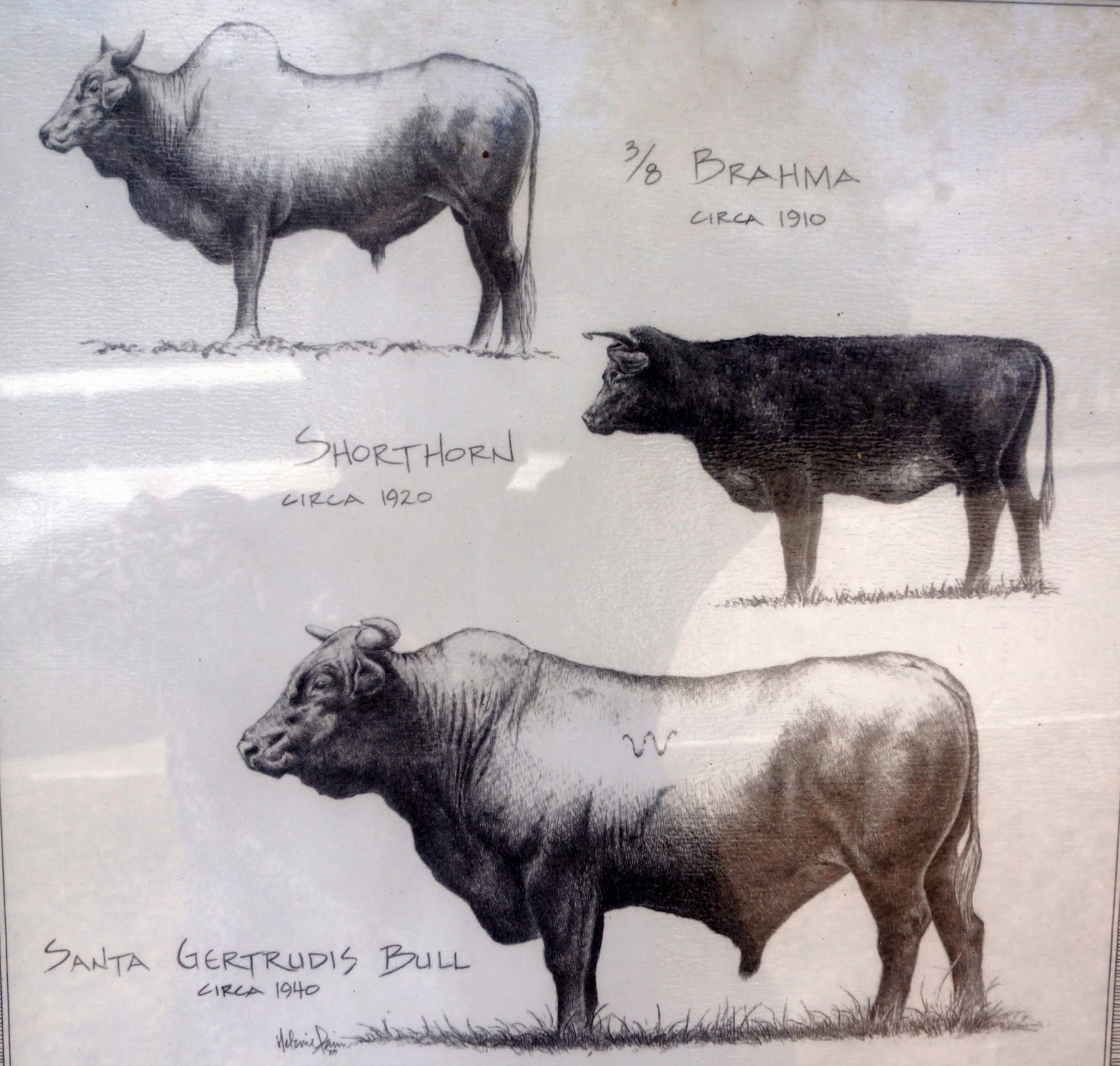
At 825,00 acres, or 1,289 square miles, the King Ranch in Texas is one of the largest ranches in the USA, though its property is not contiguous. We got the scoop on how Richard King started out, the development of cattle herds, the working quarter horses and thoroughbred racers, and more stories about his family, employees and some of the original buildings. Richard King developed a breed of cattle by crossing Brahmas with Shorthorns, resulting in a hardy breed well suited for the hot environment in Texas, called the Santa Gerturdis.


It was such a large breed that the meat packers and grocers rejected it because the cuts of meat were too large for their equipment and meat trays.  So he went on to develop a second breed, the Santa Cruz, which was smaller and is still raised today on the ranch. Here you see a few of them with the King Ranch brand, the Running W, on it.


The King Ranch cowboys of today are not like what we imagine based on old movies. They are equipped with a pickup truck, a trailer for their horse, and a cell phone. There are even port-a-potties scattered around the ranch for the cowboys' convenience. Each cowboy is responsible for ten thousand acres. 


King's original cowboys came from a town in Mexico where he bought his first cattle. King basically hired the whole town to come work for him. They and their descendants who still work on the ranch are called Kinenos (with a tilda over the second N). 


It seems that their employees of every stripe lived in Ranch housing (and still do!), making the ranch like a self-sufficient community.  They rose their own sheep and wove distinctive blankets with the King Ranch brand on them.  


The King Ranch brand is known world wide. Even Ford Motors partnered with them to offer a line of King Ranch trucks. Among other things, our tour guide explained to us about brands and shared some stories about the origin of the Running W. Bottom line - no one really knows how King came up with it. 


A few of the older buildings are modeled after The Alamo, like this stable below. 


All that we saw is only a tiny representative and historical portion of the immense King Ranch corporation.  King Ranch not only raises cattle and horses, but they have branched into all kinds of agribusiness, including sugarcane, cotton, milo, citrus, sod, pecans in Texas and in Florida.  They also own a John Deer dealership near Kingsville, a leather goods factory and store, and a publishing house. They have branched out into using their land for hunting and ecotourism. Check out their website for lots more information.

Next we'll tell you about birding in the "Tip-o-Texas."


Friday, January 31, 2014

Coolest Bike Carrier Ever!

While visiting Padre Island National Seashore and driving on the beach we encountered a French Canadian couple with this great addition to their travel set-up.  It's the KOMO Multi-Purpose Bike Carrier.  Not only does it protect your bikes from the salt, sand, road dirt, rain and theft, it provides additional storage for adventure equipment.


The bummer for us is that it is mounted on a double trailer hitch - one on each side of the vehicle's rear.  Who the heck has those? Both Ms. Subaru and our fifth-wheel already have single hitches and we can't see switching them out. But it's tempting.

Monday, January 27, 2014

The Texas "Move on Over" Lane

Around here there's a unique custom of the road to which we are becoming acclimated. If you are driving on a two land road with wide shoulders, and a car comes up fast behind you and blinks its lights, you are expected to drive onto the shoulder and let the car pass.

I was first initiated to this cultural anomaly many years ago when I was driving my little Volkswagon Bug in Texas and a big semi-truck bore down on me, flashed its lights, and literally forced me off the road. Scared the *#!!#* out of me.

Here are a few points of clarification that we've gathered so far:
  • There is no expectation that anyone will slow down during these maneuvers. 70 mph is no problem.
  • There are no exceptions made if, for instance, there are cars coming from the other direction - the moving over evidently allows cars to pass without concern for oncoming traffic. 
  • There are no markings or signs indicating that this is the customary behavior or legal use of the shoulder/right lane.
  • The maneuver can be performed without the flashing lights - the slower driver simply anticipates the needs of the car behind it and drives onto the shoulder as if it is the polite thing to do. The flashing lights seem to be for the benefit of out-of-towners like me, as if to say:

"Move on over stupid, I'm comin' around!"
(One learns quickly under these circumstances.)


Saturday, January 25, 2014

The Texas State Aquarium in Corpus Christi

This aquarium is an indoor/outdoor kind of place, so it was a perfectly sunny, 65ish kind of day for a visit. It's on the north side of Corpus (as the locals call it) just across the Harbor Bridge, which you can see in the picture below, taken in front of the aquarium. 


It's also right next to the USS Lexington, another popular attraction that we haven't visited yet.


The aquarium is situated on the Port of Corpus Christ, a busy deep water channel. While we were there a huge ship loaded with five or six windmill blades passed by.  There is a large windmill field nearby, where this ship may have been heading. This is really Rick's kind of place and he was probably more interested in the ships than the creatures inside the aquarium. He made me take this picture.


The displays are about equally divided between indoors and out, and one of the first to catch our eye was the dolphin pool, covered by this grand sunshade. 


Between shows, the dolphins are in the pool just swimming around and peeking at the visitors.


Downstairs below the pool there is an underwater viewing window, but when we got there the dolphins were somehow gone.  Throughout the aquarium there were lots of preschool aged kids with their parents. No school groups thankfully. The place was kind of empty and that was really nice for taking pictures.


Back up top, we watched the dolphin show, which was probably one of the best things there.  Several little were kids jumping and twirling around too, doing ecstatic dances about the dolphins.


Nearby there was a pool of small stingrays you could touch. They're soft and slippery.


Another large tank held a few sea turtles...


…who really like this one window a lot so it was easy to get this eye to eye perspective.


There was also an alligator pond with one alligator, a small shark tank with no sharks, an otter pool with one otter, and a small arena for wildlife shows. We went to that, but it was too bad to even mention.  Overall, I'd say this is an underwhelming aquarium (Rick says "rinky-dink"), with no really impressive exhibits or collections.  Many of the animals are rescue cases, and are alone in their tanks or cages. That always makes for a kind of sad milieu.

Inside there are several different areas, focused on different things: jellyfish, reefs, the Amazon. One tank held about ten lion fish with a map nearby showing the spread of this venomous invasive species in the Western hemisphere over the past ten years.  Scary. 


The jellyfish were my favorites. So elegant. 


There were several tanks with large and small tropical fish, and lots of opportunities for close inspection.


The Amazon exhibit seems to be the newest.  Above is a piranha and below are tiny colorful frogs (obviously). 


One last look at the otter who wants a playmate…(see us in the reflection?)


Over the next few days I'm going to try a new style of shorter blogs.  Hope you'll check them out and let me know how you like them. 

Wednesday, January 22, 2014

Padre Island National Seashore, Texas


The Gulf beaches here in Texas are all pretty similar - long flat stretches of sand with low scrub dunes - so our visit to Padre Island didn't really deliver any surprises.  It looks very much like Mustang Island, but with no commercial development, which is nice of course. 


Along the one road into the National Seashore there are some informational plaques about the cultural and natural history. Several Native Americas tribes lived here, and later there were cattle ranchers and cowboys. 


A stop at the Visitor's Center (which looks a lot like a corral, doesn't it?) and a talk by one of the rangers explained a lot about the sea life we have been seeing intermittently on the beach.  Right now the sea turtles are having trouble with the cold water temperatures in the Laguna Madre (the large shallow body of water between the islands and the mainland) where they forage. The Seashore runs daily rescue missions out into the lagoon and brings cold stunned turtles back to their facilities to revive and then relocate them.


All the beaches in Texas are considered roads, so driving on them is the norm.  Rick, Ms. Subaru and I have a hard time getting our heads around that, but we did it anyway.  Seems sacrilegious somehow. This was Ms. Subaru's first sand drive, and she earned her stripes. We'll be calling her Captain Subaru soon.


On both the gulf and the lagoon sides of the island there are several minimal service campgrounds right on the beach that look nice even for big rigs.  At "Bird Island" there is also a marina and a wind surfing launching area. We explored a little bit and saw lots of gulls and white pelicans. 


On our way out we got our pictures taken (I presume) along with everyone else passing in or out the park gates.  Do you think NSA has enough cameras here? 


Today we're going to the Texas State Aquarium in Corpus Christi, so I hope to get some good pictures of wannabe wildlife there.  Stay tuned.