"Could I have this dance for the rest of my life?" - Anne Murray
Showing posts with label local culture. Show all posts

Sunday, December 6, 2015

Boone Hall Plantation: Mount Pleasant, SC

This December we've returned to Mount Pleasant, SC to visit with family for the holidays. We're staying at the KOA, which has made some improvements since we stayed two years ago, most importanly (to us) a new dog park.  Although we've done lots of sightseeing in Mount Pleasant/Charleston in previous years, we never got to Boone Hall Plantation, one of the most popular historic destinations in the area.

The 88 live oak lined entrance to Boone Hall

The admission fee to Boone Hall covers a guided house tour, tram tour, self-guided walking tour of grounds, gardens, cotton dock and slave quarters, butterfly garden and access to the Butterfly Cafe. It easily takes at least half a day.

As we drove down the 88 tree, 3/4 mile live oak lined entrance road, we stopped  to take a picture and noted that we were standing on an old brick bridge over an unusually deep canal. Later we learned that the canal was dug during the Civil War as an effort to detain the advance of Union troops into Charleston. We also learned that the bricks had been made right at Boone Hall Plantation brickyard. 


If you love history, you'll love visiting Boone Hall. Originally a British land grant to John Boone in 1681, it has been a working plantation ever since! It's ownership has changed many times, from John Boone, to a Russian prince, to the current McRae family and others. 

The plantation house and serpentine wall


Its source of income has also changed many times: from rice, cotton, bricks and pecans to peaches, vegetables, tourism and special events.  No cotton any more due to the infestation of the boll weevil along the coast.


As we waited for the noon house tour we walked through the gardens, which were being changed over to their winter annuals. 


However, beautiful pink and white camellia bushes, unique to these semi-tropical climes, were blooming along the garden paths.  


We had just enough time to wander along the creek and visit the smokehouse.  At 250 years, the smokehouse is one of the oldest structures on the plantation.


Praise house and serpentine wall

After walking along the serpentine wall (invented by Thomas Jefferson) we headed back to the big house for the tour.


Our tour guide was entertaining and informative as she took us through the downstairs of the period antique furnished house, where no pictures were allowed. They were in the process of decorating for Christmas with hundreds of poinsettias and a couple of trees in every room, each one decorated uniquely. One was decorated completely with cotton balls right off the bush (surprisingly effective) and another with woven sweet grass ornaments.  This house is not the original Boone home; it is actually the fourth building on the site, the others having been lost to fire and or torn down for this new structure by Thomas Stone in the early 20th century designed after the traditional southern plantation style.

After the tour we made our way back to the row of brick slave cabins along the oak avenue. Typically the slave houses are placed in back where visiting guests wouldn't see them, but historians guess that this land was the only acreage on the plantation that was not farmable because it flooded regularly with salt water. So they built the slave cabins there. 

Each of about eight cabins has a display inside with either an audio or visual recording explaining the display. The first house was described as the "praise house" where slaves were allowed to worship separately from their white owners and overseers.   Music, audio description, mannequins and informative plaques explained the history of worship tradition among the slaves, as well as notable spiritual leaders of the time. Other cabins housed displays about dimensions of slave life, emancipation, archeology, agriculture, etc.


Sweet grass baskets are still a highly prized traditional craft of the local Gullah people and are sold along Rt. 17 in Mount Pleasant. Here too a local artisan sells her baskets and explains about the art form.


Sweet grass basket detail

A local historian was available to answer questions and expound on topics of his choosing outside  one of the cabins. 


These houses are not in their original condition, as they were destroyed by Hurricane Hugo in 1989. They are constructed of the same bricks, which were made in the plantation brickyard. The tile roofs replaced the original wood. 


Another building on the plantation that was seriously damaged by Hurricane Hugo is the cotton gin. As most readers will know, the cotton gin (short for engine) revolutionized cotton production by providing a fast and efficient method of processing the cotton after picking. The large buildings that house the gin are also called gins. There are still many modern gins in operation throughout the south.  This gin had been used as a gift shop and restaurant until the hurricane almost destroyed it. Now it is braced and waiting for a planned multi-million dollar renovation.


We finished our visit with a chilly open air tram tour around agricultural fields of the plantation. Our guide told us more about the history and current use of the plantation. We drove through peach orchards and strawberry fields (that will be ripe in two weeks!). Produce from the farm is sold locally to agricultural cooperatives.


As Christmas approaches our family activities intensify. We'll be visiting, dining out, shopping, having meals at one another's homes, baking cookings, and dancing. There's a nice contradance in North Charleston and one of our nieces is an avid ballroom dancer. We've promised to attend her dance if she'll attend ours, so we anticipate even more dancing and holiday fun.

Sunday, November 15, 2015

The Alabama Shoals, Part Three: Tuscumbia

The Shoals is an area in northwestern Alabama named for the the shape and texture of the Tennessee River as it passed through the area. In order to make the river navigable, dams and locks were built, so that now there is a wide river and a series of lakes that are popular for sailing and fishing. 

A cluster of four towns make up the residential area here: Muscle Shoals, Florence, Sheffield and Tuscumbia. On one lovely afternoon I took a little artist's holiday by myself to explore and ended up spending most of my time in Tuscumbia, known mostly for Ivy Green, birthplace of Helen Keller. 

Helen Keller's birthplace
It's a small, quaint home, typical of the well-kept places we've seen throughout the area. Tucked away in a side structure, I found the video of a dramatization of Helen Keller speaking to a convention of the Lion's Club to be the most interesting part of the visit. Her speech was passionate and bold, as she asked for the Lion's Club support for blind deaf children. Although this was a dramatization, it must reflect the remarkable strength of the woman she was.  

The downtown of Tuscumbia itself seems to be suspended somewhere between collapse and revitalization like so many towns we've seen across the country. I'd say its leaning more toward revitalization right now. The county courthouse is spectacular (sorry no photo), and there is a large attractive local bookstore on the main corner that seems to be the downtown hotspot.

Best of all, from my perspective, is Spring Park, named for the Big Spring around which the town's history and development centered. 

Cold Water Falls
A sign claims that these are the largest man-made stone water falls known. The spring fills a large pond inhabited by fish, turtles and lots of waterfowl. 


It runs out through a dam, into Spring Creek...


under a covered bridge...


and a swinging bridge,


carving interesting caves and shelves in the limestone as it flows away.


In addition to the beautiful water features, the park is equipped with trails, picnic tables and shelters, playgrounds, an amusement park and a children's train that circumvents the whole shebang.  Oh, and the Claunch Cafe where I stopped for a little bit of refreshment along the way.


I think that Southerners really "get" cake. This is the slice of Claunch's unique Hibiscus Cake. Definitely great homemade cake.

That wraps up our week in The Shoals. There's more here to see and do, like the Coon Dog Cemetery, the Alabama Music Hall of Fame and the Muscle Shoals music scene, so I hope you'll come see it for yourself sometime. 

Alabama Shoals, Part Two: Florence

I am loving Alabama! As I've owned before, I am a Northerner. Every time I come south I'm surprised by how beautiful it is. Many Northerner's like Rick and me have a lot of baggage when it comes to the south and we just have to get over it. We were inundated in school with images of poverty, flat cotton fields, little shacks and other horrors. (Neil Young didn't help.) I offer my apologies. 

Our first stop in Muscle Shoals was the Wilson Dam on the Tennessee River. We looked out across Wilson Lake, read about the TVA and drove across the dam into Florence. The town of Florence is a great example of the lovely towns we've encountered here. It's a college town (University of North Alabama), and so it clearly benefits from the influx of people and money brought by the college. The downtown was about five blocks of interesting shops and restaurants.  But more than that, like other areas of Alabama we've visited, there's a pride of place. People seem to be committed to making their homes and towns beautiful.  Thanks Alabama.

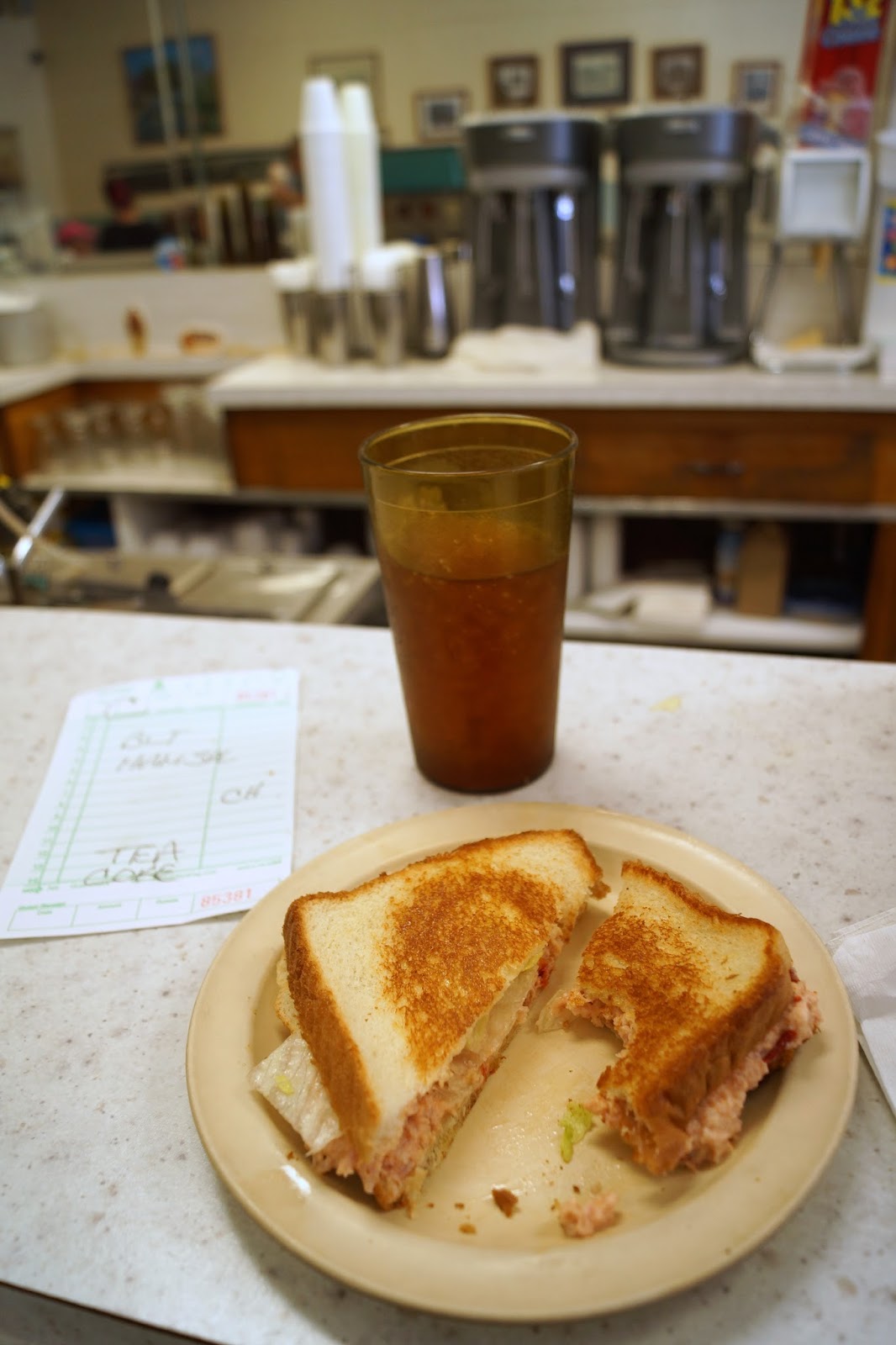
We chose to have lunch at Trowbridge's, a longtime local favorite right out everyone's memory of the good ole' days. Think Andy Griffith.

Ham salad sandwich and ice tea

We sat at the counter. The service was fast and no nonsense, but friendly. The prices were from another decade, and the food itself was too. Remember when lunch looked like this? Small plates, small sandwich, small ice cream sundae.

The counter and the menu

For dessert, Rick had a chocolate ice cream soda, which is really hard to find in this day and age. I had Trowbridge's famous orange pineapple ice cream in a hot fudge sundae. Yum. We both left happy.

Oops! Where'd that cherry go?


Trowbridge's Ice Cream and Sandwich Shop, Court St., Florence

We went looking for the Visitor's Center and found the Frank Lloyd Wright Rosenbaum House. Another one! We didn't choose to take the tour. It looked like the other Usonian homes we've seen, like Kentuck Knob, but maybe more modest. This one is unusual in that it's in a residential neighborhood.  We just stopped long enough to take a few outside pictures.


We finally found the Visitor's Center and what a surprise it was! It was like a high-end museum devoted to all things Florence and the surrounding area. 


Check out the architecture and the floor art representing the river and the shoals that the area is named for.


Lee, the helpful and friendly woman hosting the center that day, directed us on to our next stop, Tom's Wall, or as Tom calls it, The Wichahpi Commemorative Stone Wall.

Rick and Lee at the Florence Visitor's Center


Tom greeted us at his driveway and welcomed us in, inviting us to join him on a few plastic chairs so he could give us a little talk.

Tom Hendrix

He told us the story of his great grandmother, Te-lah-nay, a member of the Yuchi tribe, who along with thousands of other Native Americas was displaced and relocated to Oklahoma during what has come to be called the Trail of Tears.  After arriving there, she made the remarkable choice to turn around and return, walking all the way by herself back to her home on "The Singing River." This wall is his tribute to her brave five year journey, during which she was in constant danger of being caught, returned or killed.


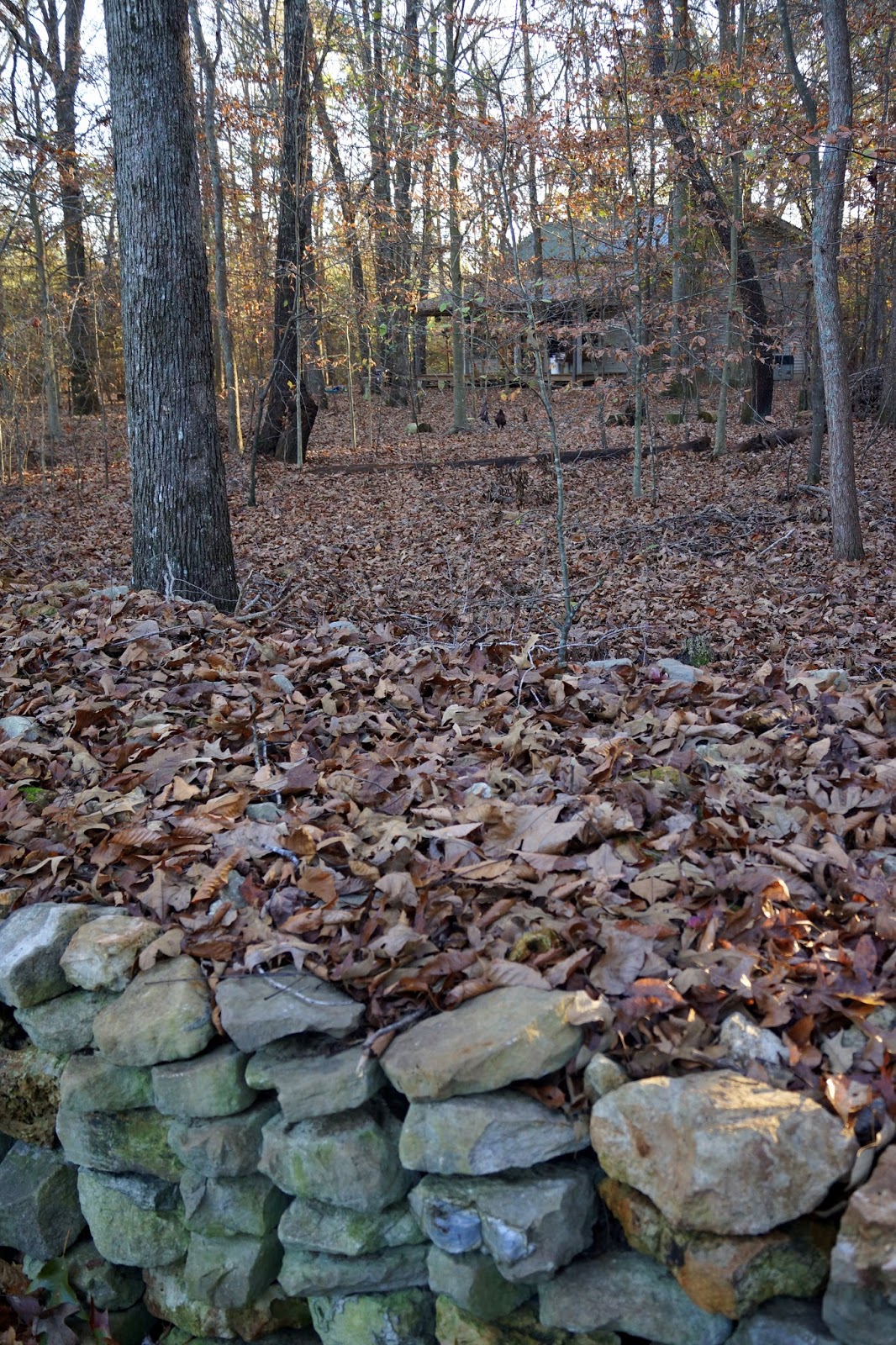
Tom built this wall by himself, placing "a rock for every step she took." He estimates that he's lifted eight million pounds of stone. In some places it's five feet hight and 27 feet wide.

"This is a sacred women's place" says Tom. 

The wall is shaped into sitting areas for individuals and groups at various places along the walk, including one near the entrance shaped like a womb.


People have come from all over the world to see Tom's Wall, and some send back special rocks to add to his wall. Tom seems happy to tell stories about every rock.


Tom and his wife live in a small house next to the wall. He charges no admission but does sell stone sculptures he's created to help cover the cost of moth balls to keep the copper heads away.  Large donations he passes on to a charity for Native Americas girls. 


It was a soulful kind of visit with Tom and his creation. People like Tom who devote their lives to their passion make life more meaningful for everyone. We headed back home on the beautiful Natchez Trace with our hearts warmed.

The Natchez Trace

(Just have to finish with this plaque from the Florence Visitor's Center. I know it's a favorite among full-timers.)


Thursday, October 15, 2015

Oklahoma City is Booming!

We are not city friendly folks, but after an overnight in Oklahoma City (OKC) we were impressed. Before we even knew the stats, we could tell it was thriving. So we looked it up while we were driving back to Grove. Here's what some of the numbers say:

OKC has grown 5% since the 2010 census according to a CNN Money article about the 10 fastest growing cities in the USA. According to Forbes, the unemployment rate was 3.1% in 2015.  The OKC Chamber of Commerce lists many accolades, including Entrepreneur's #1 for starting a new business. Its growth has traditionally been based in livestock and petroleum products, but new tech development has been recognized in the current and forecasted boom.

We loaded up Honey in the car and treated ourselves to a break from the RV so we could check out OKC.  We stayed at the La Quinta Inn, which always allows dogs without an additional charge and is usually a nice place. It was Honey's first visit to a hotel, and she was excited (of course she's always pretty excited), but she handled it well. We were able to leave her in the motel while we went out for dinner and to see the Capitol building the next day. But first we all went downtown to the Myriad Botanical Gardens, which has a dog park! It also allows pets throughout the gardens. Happy Honey!


She wasn't the only happy one. The temperature was delightful, the air was clean and crisp, and the garden was full of fun things to photograph. The landscaping was in Fall mode - end of season grasses, year round shrubs, evergreens and trees with a bit of Fall color. The park is very strong architecturally, with an emphasis on geometric forms rather than flowers, at least at this time of year.   


The primary focal point from almost every location is the Devon Energy Building. Everything else seems to play off that building. 


Down the center of the park is a ravine with a pond/river running through it. Pictured below is a foot bridge, many-leveled paths along the river and an amphitheater.


The river is fed and complemented by various other water features. Here Rick is taking a video  capturing the changing beauty of this wave pool.


The wave pool/waterfall is right next to a band shell...


...that was a lot of fun to photograph. Here it is in relation to the Devon Energy Building...


...and the sun.


A major feature of the park is the Crystal Bridge Tropical Conservatory...


...which houses, yes, tropical plants. We missed going in, as it closes at 5pm.


There is a restaurant, also closed when we were there.


We finished with another visit to the dog park. It's a small park with astro turf and gravel, but it has fresh drinking water for the dogs, bags, shade, and seating for the people. Honey got a little play time with another visiting dog, so she was all set for a quiet evening. 

Next day we left Honey in the hotel room again and went to the Oklahoma State Capitol.  It has an immediately noticeable unique feature: an oil well right in front. 


Also in front was this statue by Allan Houser, well known Native American sculptor, entitled "As Long as Water Flows." I guess the oil rig says "As Long as Oil Flows."  The economy in Oklahoma is certainly dependent on that flowing too.


The Capitol has what we now recognize as the traditional Capitol architectural plan modeled after the US Capitol: two major wings, and front and back entrance foyers with staircases, all extending away from a multi-storied central rotunda. 


Each state varies the design with unique murals, artwork, architectural detail, and color schemes that reflect the character of their state.  


There seemed to be less intrinsic symbolism in this building than the last four we've seen. There were however many references to Native American culture and history. 


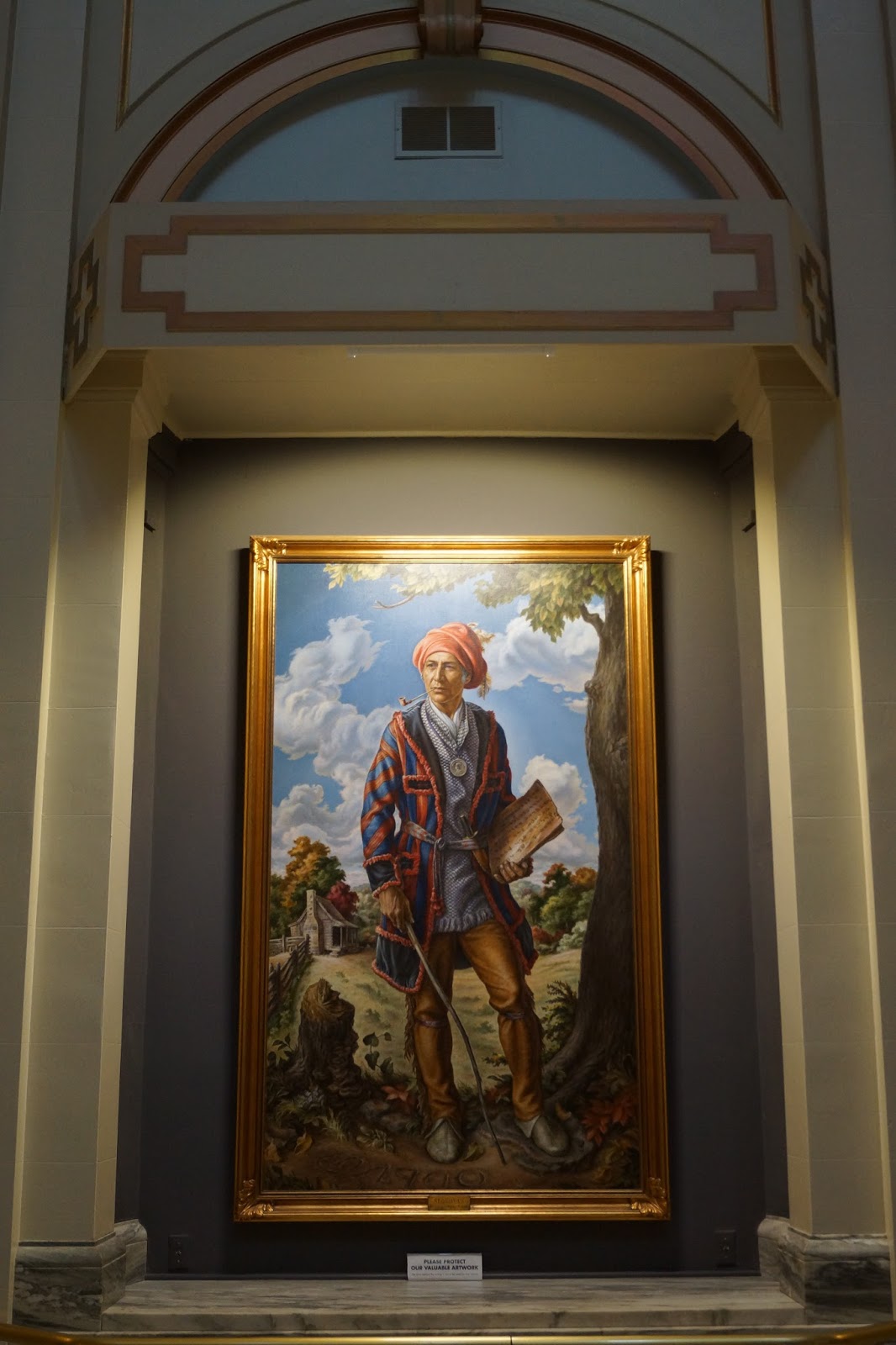
There is a striking collection of portraits throughout the building, including this one of Sequoyah, an illiterate (couldn't read or write any language) Cherokee man who single handedly invented and then taught the Cherokee alphabet and written language. He was also committed to the unification of the Cherokee Nation. 


One of the newest works of art in the Capitol is "Beyond the Centinnial" by Carlos Tello (2010).  The Iron Man-like figure in the center represents every Oklahoman, holding the future of the state in his hands. We thought it was a little bizarre.


Through the circle of lights below you can see one of the most beloved works of art in the building,  "Flight of Spirit" by Mike Larsen (1991). In the foreground it depicts five Native American ballerinas, with other Native dancers and artists behind them. One of the ballerinas is Maria Tallchief, whom I idolized as a little girl. 


This replica of the 22' statue called The Guardian, that tops the Capitol Dome, stands at the top of the front grand staircase.


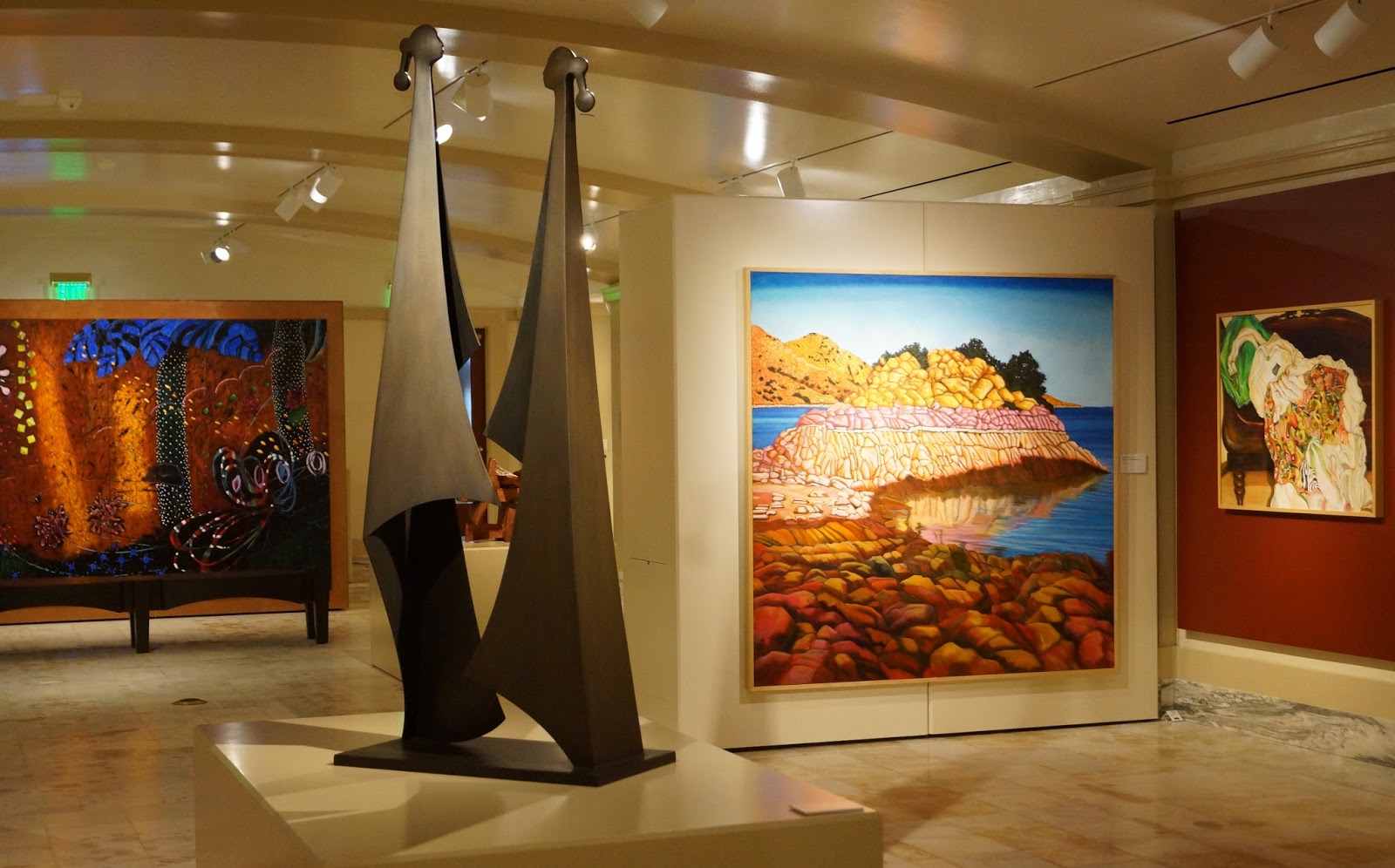
On the first floor there are several additional galleries that hold temporary displays; at this time they are wonderful contemporary collections. We thought the quality and selection of the art throughout the Capitol was remarkable and would recommend a visit to the building for any art lover. 


I'll close with this portrait of Woody Guthrie, one of my heroes. He was a singer/songwriter of the American people, from my parents' generation. I grew up singing his songs and didn't even know it.  I can't help but think how I learned of his worldview through music, a powerful medium, and how it influenced who I am and what I'm doing today.


This Land Is Your Land
Words and Music by Woody Guthrie

This land is your land, this land is my land
From California to the New York island;
From the red wood forest to the Gulf Stream waters
This land was made for you and me.

As I was walking that ribbon of highway,
I saw above me that endless skyway:
I saw below me that golden valley:
This land was made for you and me.

I've roamed and rambled and I followed my footsteps
To the sparkling sands of her diamond deserts;
And all around me a voice was sounding:
This land was made for you and me.

When the sun came shining, and I was strolling,
And the wheat fields waving and the dust clouds rolling,
As the fog was lifting a voice was chanting:
This land was made for you and me...