"Could I have this dance for the rest of my life?" - Anne Murray
Showing posts with label museum. Show all posts

Saturday, December 26, 2015

A Quick Overnight in Historical Savannah, GA

An old friend of Rick's from their New York Maritime days, Kevin McCarey, invited us down to Savannah to visit one of the city's many museums and have dinner with he and his wife Fran. Sounded like a fun get away to us. It may seem strange that we feel the need to get away at times from the life we live, but like everyone else, we get into our ruts and it's good to change things up sometimes. We packed for one night and drove the two hours from Charleston, SC to Savannah GA.


When we have to stay overnight away from the RV with our dog Honey, we usually look for a La Quinta Inn because they are pet-friendly and don't charge an extra pet fee. They aren't a fancy hotel in any way, but usually they suffice. There are three La Quintas in Savannah, but based on my research online, I thought they looked a bit too time worn. So for one night we decided to splurge and stay downtown in the historic district at The Brice, a pet-friendly boutique hotel. This was a first for us and we were really glad we stayed there.

The Brice Hotel

Looking up in the foyer at The Brice

After being greeted enthusiastically (with major dog treats!) by the valet, the concierge and the front desk, we went to our room to settle in. The hotel website had promised a dog bed and dog dishes for Honey, but they weren't in the room, probably because we had checked in early. One call to the front desk, and all her accoutrements showed up in a flash, along with another treat.

One of three 7" gourmet dog cookies Honey got at The Brice

The decor of the hotel is what I'd call new urban funky chic, but not in an extreme way. This is historical Savannah, so of course there is tradition mixed into a more contemporary ambiance. The guest rooms and common spaces were interesting, comfy and somewhat unconventional, at least compared to La Quinta.

Common space off the lobby at The Brice


The lobby of The Brice


The Brice has a restaurant, called Pacci, which we didn't try, but looked pretty. It also has an outdoor pool, which also looked nice. I think the hotel just opened this year in this renovated warehouse building. It used to be a Coca-Cola bottling factory, among other things over the years.

Pacci - the restaurant at The Brice
The "Secret Garden" 

Our room had more than the typical amenities: a well stocked minibar and bathroom, lots of unusual throw pillows, extremely comfy beds and a unique selection of art on the walls.  Everything was very clean and fresh. 

Our room at The Brice

Funky chic decor at The Brice

Your photographer

We left Honey to luxuriate in the room and asked the front desk to call a Pedicab for us. While we waited out front Rick and the valets and concierge talked football. (Amazing where you find Patriot's fans.)  Our Pedicab driver Royce, ("Ride with Royce and Rejoice!") peddled us slowly through the narrow streets and historical squares while chatting in a friendly way about Savannah.  I am convinced that "Pedicabbing" is the best way to see Savannah, as long as the weather is good. It's slow, calm, safe and so scenic. You pay your driver what you think he or she deserves, unless you are renting by the hour.  

Rick and Royce or Boyce (we disagree in our memory of his name) our Pedicab chauffeur

Royce dropped us at the Jepson Center, one of several Telfair Museums in Savannah, where they were having an exhibit called Monet and American Impressionism. (No photos allowed.) 

The Jepson Center

We met Kevin there, where he is a member, and he generously treated us to the exhibit. In addition to being a classmate of Rick's from the SUNY Maritime College, Kevin is an author and filmmaker who currently teaches at Savannah College of Art and Design (acronym SCAD, which has a very strong presence in Savannah).  Kevin has made an outstanding documentary film about Frederick Freiseke, one of the American Impressionists featured in this exhibit. He was the perfect tour guide.  

Kevin and Rick reunite

Afterwards Kevin took us for a long stroll through historic Savannah as the sun set. One beautiful garden square after another is what Savannah is known for.  

The Mercer Williams House of Midnight in the Garden of Good and Evil fame


Historic Temple Mickve Israel


One of many historic inns and B&Bs


Sunset in historic Savannah

The temperature was perfect and we could have walked forever, but we worked our way to Bella Napoli, a cozy Italian restaurant, where we met Fran for lovely dinner.

Bella Napoli

Kevin walked us back to our hotel where Honey was happy to see us. She hadn't gotten into any mischief.  After a good night's sleep we got up early to take Honey for a long walk and find ourselves some breakfast. Our walk took us along the upper levels of Savannah's historic waterfront.  The row of buildings are old multi-storied warehouses of cotton companies converted into restaurants, boutiques and other businesses. From the sidewalk we were on we could look down to the lower level basements and the original cobblestone streets leading down to the river. 


It's a complex and beautiful historic neighborhood I'd like to explore more. 


We ended up at Goose Feathers Cafe for a tasty and inexpensive breakfast of croissants, cinnamon rolls and coffee at their pet friendly outdoor seating. Savannah is dog friendly, with lots of outdoor seating, water dishes, and specialty stores for dogs.  We wound our way back to the hotel, through many of the beautiful squares again, and checked out from the Brice where we had felt so pampered.  It was really hard not to stay longer. 


Before leaving Savannah, Honey and I found Daffin Dog Park while Rick went to the elegant Ships of the Sea Maritime Museum.  Everybody was happy, aesthetically pleased and well cared for by the time we headed back to Charleston.  I hope we return to Savannah for an extended visit someday soon.

Thursday, October 15, 2015

Oklahoma City is Booming!

We are not city friendly folks, but after an overnight in Oklahoma City (OKC) we were impressed. Before we even knew the stats, we could tell it was thriving. So we looked it up while we were driving back to Grove. Here's what some of the numbers say:

OKC has grown 5% since the 2010 census according to a CNN Money article about the 10 fastest growing cities in the USA. According to Forbes, the unemployment rate was 3.1% in 2015.  The OKC Chamber of Commerce lists many accolades, including Entrepreneur's #1 for starting a new business. Its growth has traditionally been based in livestock and petroleum products, but new tech development has been recognized in the current and forecasted boom.

We loaded up Honey in the car and treated ourselves to a break from the RV so we could check out OKC.  We stayed at the La Quinta Inn, which always allows dogs without an additional charge and is usually a nice place. It was Honey's first visit to a hotel, and she was excited (of course she's always pretty excited), but she handled it well. We were able to leave her in the motel while we went out for dinner and to see the Capitol building the next day. But first we all went downtown to the Myriad Botanical Gardens, which has a dog park! It also allows pets throughout the gardens. Happy Honey!


She wasn't the only happy one. The temperature was delightful, the air was clean and crisp, and the garden was full of fun things to photograph. The landscaping was in Fall mode - end of season grasses, year round shrubs, evergreens and trees with a bit of Fall color. The park is very strong architecturally, with an emphasis on geometric forms rather than flowers, at least at this time of year.   


The primary focal point from almost every location is the Devon Energy Building. Everything else seems to play off that building. 


Down the center of the park is a ravine with a pond/river running through it. Pictured below is a foot bridge, many-leveled paths along the river and an amphitheater.


The river is fed and complemented by various other water features. Here Rick is taking a video  capturing the changing beauty of this wave pool.


The wave pool/waterfall is right next to a band shell...


...that was a lot of fun to photograph. Here it is in relation to the Devon Energy Building...


...and the sun.


A major feature of the park is the Crystal Bridge Tropical Conservatory...


...which houses, yes, tropical plants. We missed going in, as it closes at 5pm.


There is a restaurant, also closed when we were there.


We finished with another visit to the dog park. It's a small park with astro turf and gravel, but it has fresh drinking water for the dogs, bags, shade, and seating for the people. Honey got a little play time with another visiting dog, so she was all set for a quiet evening. 

Next day we left Honey in the hotel room again and went to the Oklahoma State Capitol.  It has an immediately noticeable unique feature: an oil well right in front. 


Also in front was this statue by Allan Houser, well known Native American sculptor, entitled "As Long as Water Flows." I guess the oil rig says "As Long as Oil Flows."  The economy in Oklahoma is certainly dependent on that flowing too.


The Capitol has what we now recognize as the traditional Capitol architectural plan modeled after the US Capitol: two major wings, and front and back entrance foyers with staircases, all extending away from a multi-storied central rotunda. 


Each state varies the design with unique murals, artwork, architectural detail, and color schemes that reflect the character of their state.  


There seemed to be less intrinsic symbolism in this building than the last four we've seen. There were however many references to Native American culture and history. 


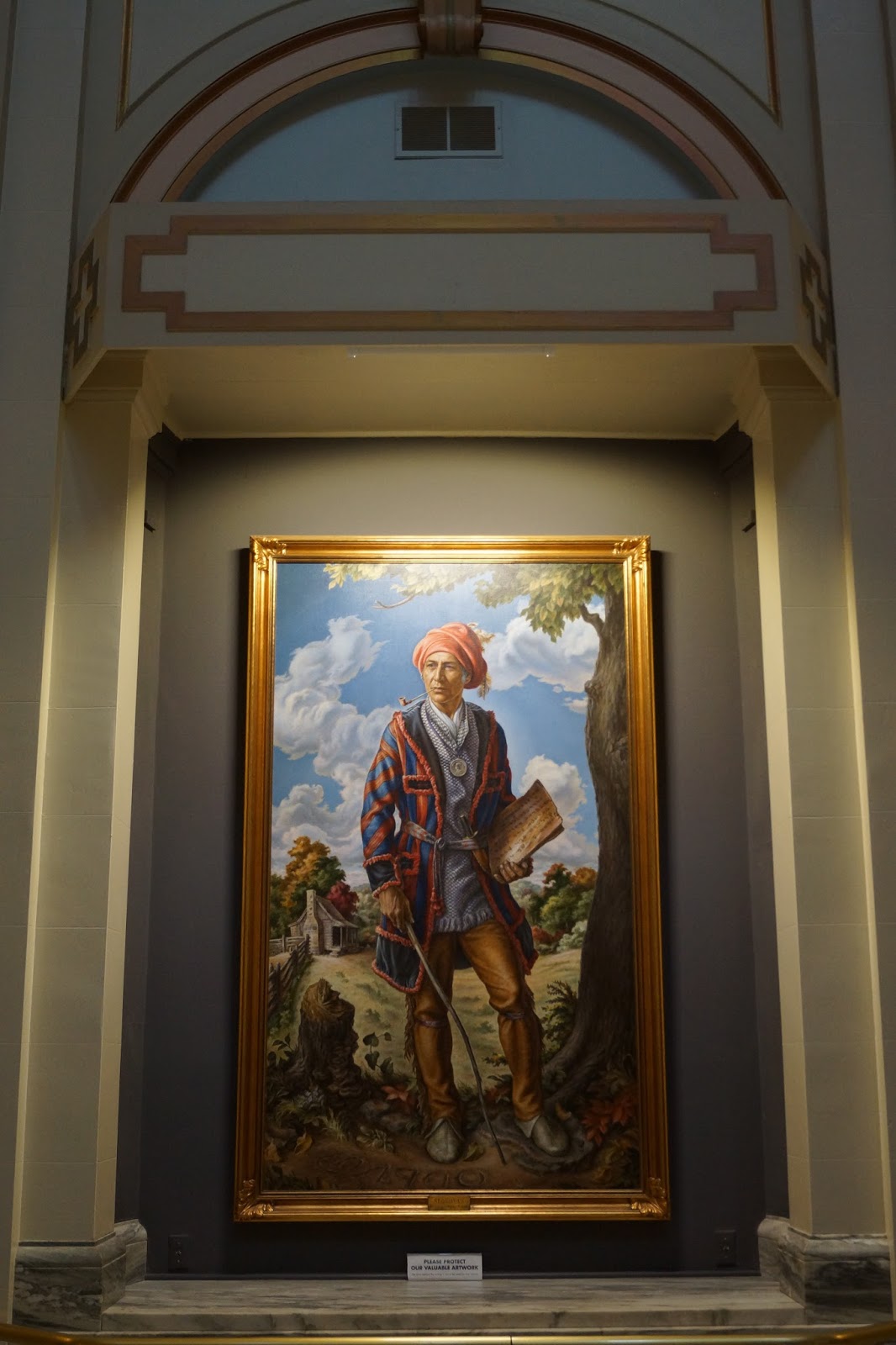
There is a striking collection of portraits throughout the building, including this one of Sequoyah, an illiterate (couldn't read or write any language) Cherokee man who single handedly invented and then taught the Cherokee alphabet and written language. He was also committed to the unification of the Cherokee Nation. 


One of the newest works of art in the Capitol is "Beyond the Centinnial" by Carlos Tello (2010).  The Iron Man-like figure in the center represents every Oklahoman, holding the future of the state in his hands. We thought it was a little bizarre.


Through the circle of lights below you can see one of the most beloved works of art in the building,  "Flight of Spirit" by Mike Larsen (1991). In the foreground it depicts five Native American ballerinas, with other Native dancers and artists behind them. One of the ballerinas is Maria Tallchief, whom I idolized as a little girl. 


This replica of the 22' statue called The Guardian, that tops the Capitol Dome, stands at the top of the front grand staircase.


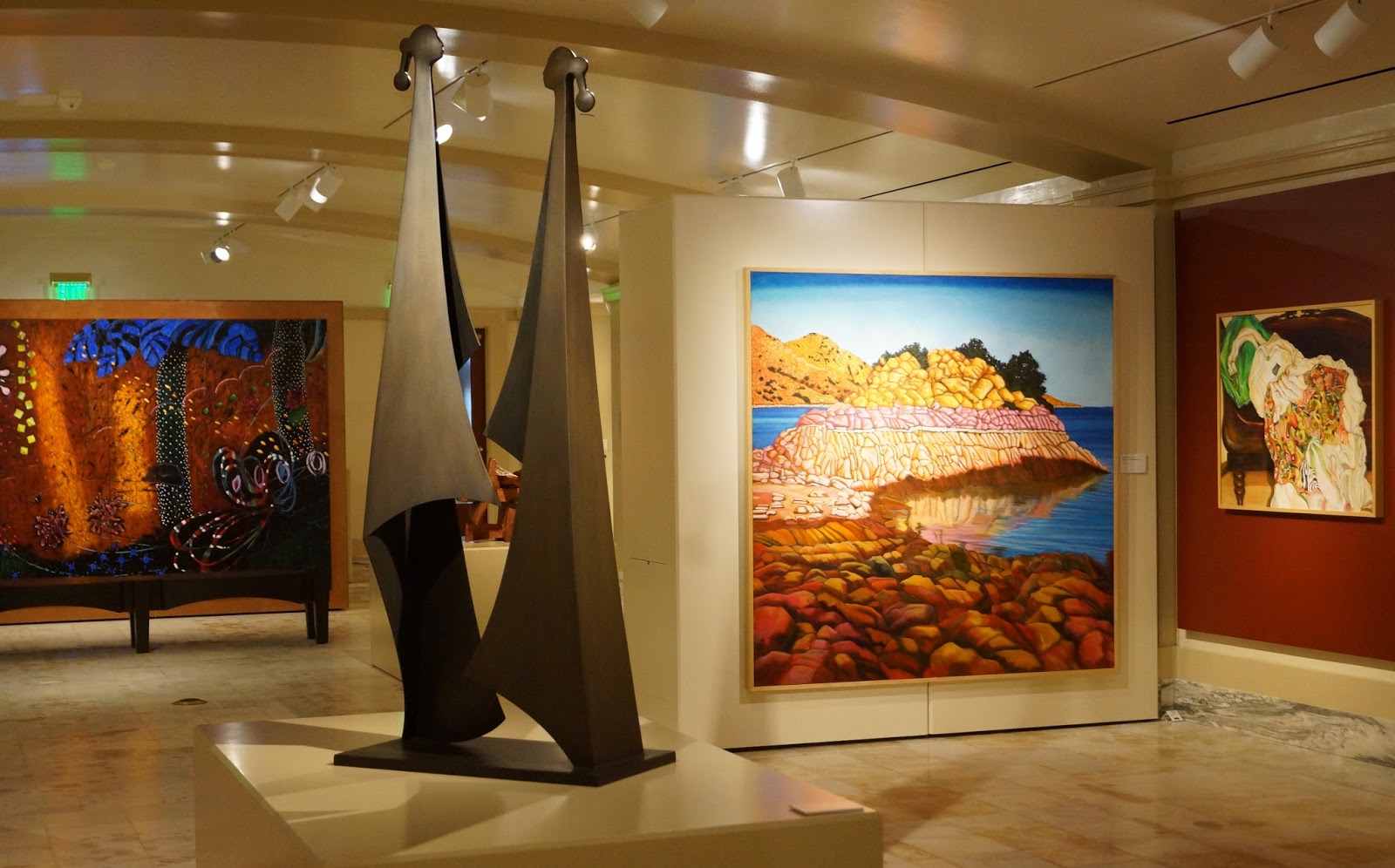
On the first floor there are several additional galleries that hold temporary displays; at this time they are wonderful contemporary collections. We thought the quality and selection of the art throughout the Capitol was remarkable and would recommend a visit to the building for any art lover. 


I'll close with this portrait of Woody Guthrie, one of my heroes. He was a singer/songwriter of the American people, from my parents' generation. I grew up singing his songs and didn't even know it.  I can't help but think how I learned of his worldview through music, a powerful medium, and how it influenced who I am and what I'm doing today.


This Land Is Your Land
Words and Music by Woody Guthrie

This land is your land, this land is my land
From California to the New York island;
From the red wood forest to the Gulf Stream waters
This land was made for you and me.

As I was walking that ribbon of highway,
I saw above me that endless skyway:
I saw below me that golden valley:
This land was made for you and me.

I've roamed and rambled and I followed my footsteps
To the sparkling sands of her diamond deserts;
And all around me a voice was sounding:
This land was made for you and me.

When the sun came shining, and I was strolling,
And the wheat fields waving and the dust clouds rolling,
As the fog was lifting a voice was chanting:
This land was made for you and me...

Monday, October 12, 2015

Oil heritage in Bartlesville, Oklahoma

Like we did, most readers probably think of Oklahoma as flat, dry, dusty and brown. But take a look at the satellite view of Oklahoma. About halfway through, from west to east, it starts to change from the omnipresent brown of the American West, to shades of green. At first it's just subtle, but by the time you reach the border of Arkansas, the green is deep and dark, like the Land of OZ compared to Kansas.  Oklahoma is definitely not just a big dust bowl.


We're spending a few weeks in the midst of all that verdant landscape in eastern OK. Of course, where you find green, you also find water; there are hundreds of lakes here, many of them very large reservoirs.  Right now we're parked on the shores of Grand Lake-o'-the Cherokees, one of the largest, at Cedar Oaks RV Park for a week.  Last week we were in Bartlesville, at the only RV park in town, Riverside RV Park. This post will be about our visit to Bartlesville where we first started seeing signs of the south: heavy vines hanging from the trees, armadillos on the side of the road and aisles of ham in the grocery store.

Bartlesville is the home of the first commercial oil well in Oklahoma and the Conoco Phillips Company (think Phillips 66). Scattered through the town there are small oil pumps and tanks, (in people's backyards, vacant lots, along the bike path) where a subtle, but not unpleasant aroma of crude oil lingers. 

There are several other attractions that Bartlesville is known for: Frank Lloyd Wright's Price Tower, Frank Phillip's home, and Frank Phillip's ranch and museum, Woolaroc. Our first stop was the Price Tower, behind the big 66 sculpture below.


One of only two built "skyscrapers" designed by Frank Lloyd Wright, the Tower was commissioned by Bartlesville oil pipeline businessman, Harold C. Price for his business.  Wright created it as a mixed purpose building with residences, retail and corporate offices throughout the building.


It is now used as an Arts Center, small hotel and restaurant, and is preserved for future appreciation.   We certainly appreciated it, especially after seeing so many of his other buildings in our travels. 


We took a tour through the building, but no photos were allowed. (I took the following two photos in the reception area before I was informed.) 


As with other FLW buildings, every little detail, like the vents, lights and all the furniture is designed to compliment the integrity of the whole. Another typical FLW feature is the built-in furniture, like the (uncomfortable) orange sofa bench below in the reception area. Before leaving we also had a good and reasonably priced lunch in the Copper Restaurant/Bar.


Right next door is the Bartlesville Community Center, designed by the Frank Lloyd Wright architectural firm, which we just appreciated from the outside.


Our next local adventure was Woolaroc, the ranch home of oilman Frank Phillips, founder of Phillips 66 Petroleum. It's about 12 miles outside of town, and is a combination wildlife refuge, historical home and museum, all created by Phillips in his lifetime.

Recreation of an old Phillips 66 gas station.

Uncle Frank was a funny guy.

Although Frank was an advocate of Native American culture and peoples, some of the representations on the ranch are a little dated.


Though he started out as a barber, after striking oil in Oklahoma Frank Phillips eventually became a very wealthy man. At his ranch home he entertained many people, some rich and famous, and some potential investors in his company. The log ranch house was built to entertain his guests.


Frank decorated his rustic cabin with the heads of domestic and exotic animals on his ranch that "died of natural causes." (The docent went out of his way to tell us that. Perhaps they've gotten some flak from animal protection folks.) There were A LOT of animal heads in that room. He also had a beautiful and extensive collection of Native American rugs and blankets both in the cabin and in the museum.


All the logs in the cabin are bark covered, but the bark was first completely stripped, soaked, finished, reapplied and sealed in a chemical process invented by Phillips' company.  They made picture frames for all the artwork in the museum with bark treated in the same manner. They even covered the Steinway piano in bark. (Can you imagine Mr. Steinway rolling over in his grave?

The bark covered Steinway

The dining room.

Our main reason for visiting Woolerac was the extensive museum that houses a vast collection of highest quality Native American artifacts and art, western American art and other historical collections.

Front door of the museum

We've seen lots of Native American museums in our travels, but something we really appreciated about this one was that it covered many different areas of the USA and many different tribes. This offered an opportunity to compare and contrast their cultures and aesthetics. There were also formal oil portraits of prominent tribal chiefs by a single artist, again offering a chance to appreciate the unique tribal regalia and characteristics.

Huge pottery collection

Rooms and rooms of art by and about Native Americans

My favorite item in the museum was this mechanical diorama of a Native American dance, complete with a recording of actual drumming and singing.  The dancing and drumming figures in the diorama all moved in rhythm with the recorded music that pulsed up from the base of the diorama through the floor. Whether jumping, turning, swaying, drumming or singing, the figures moved in a synchronous and surprisingly natural way.


Amongst the western art collection there was a fascinating display of twelve statues of "The Pioneer Woman" with huge variety in their style and imagery, ranging from a Venus-like near nude (third from the front below), to a harried working woman, to the older woman at the front of this photo. 


Most impressive was the huge exhibit entitled "The Best of the Best: Contemporary Wildlife Art" featuring seven painters and sculptures. We both could have spent hours in this room alone.


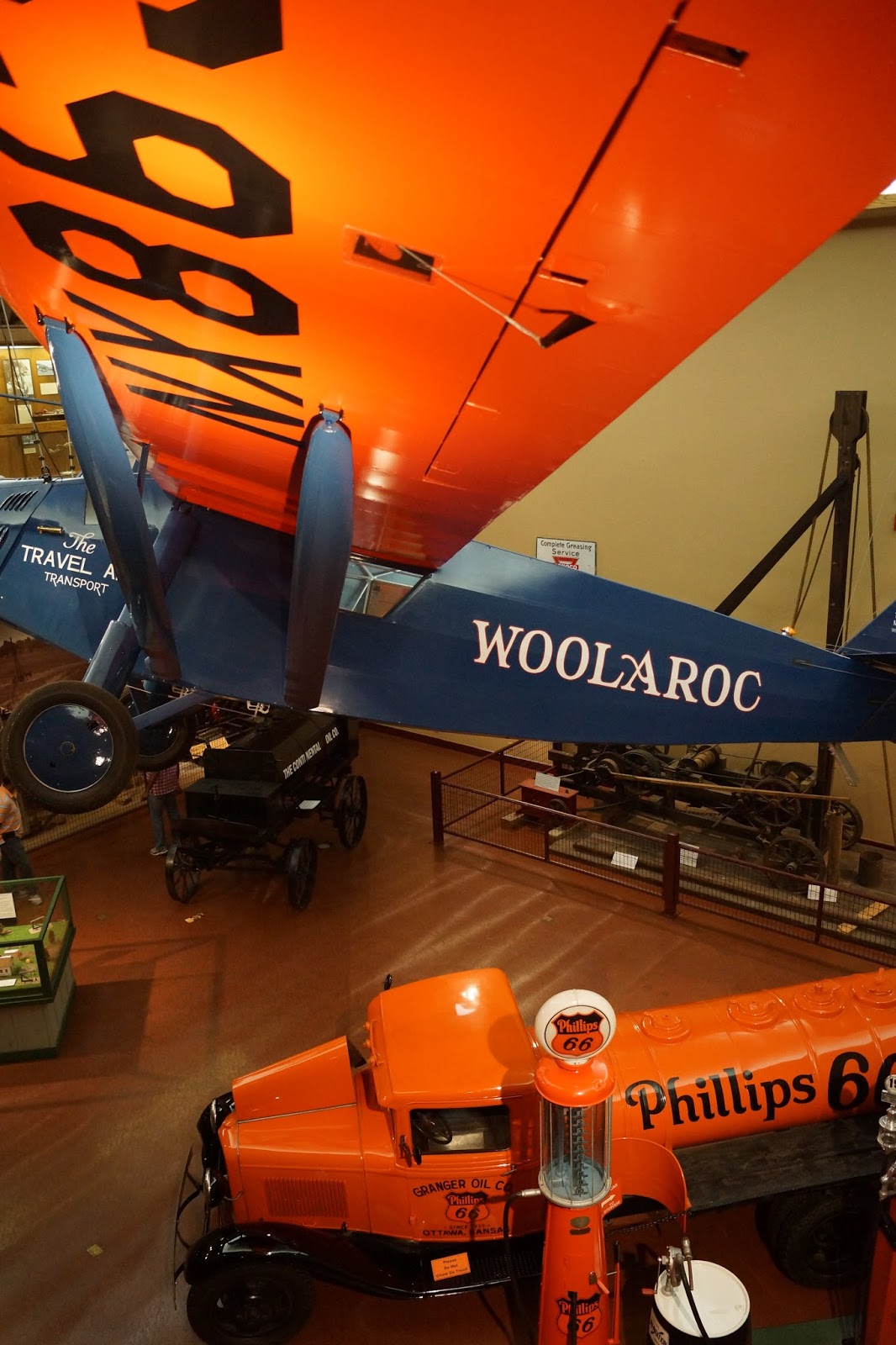
This is the airplane that started it all. The museum grew out of the need to find a place to keep the plane.


Phew! That was a full day.  The next day we visited the Phillips family home in town, which was much more traditional and seemed to reflect his wife Jane's personality while the ranch was all Frank.


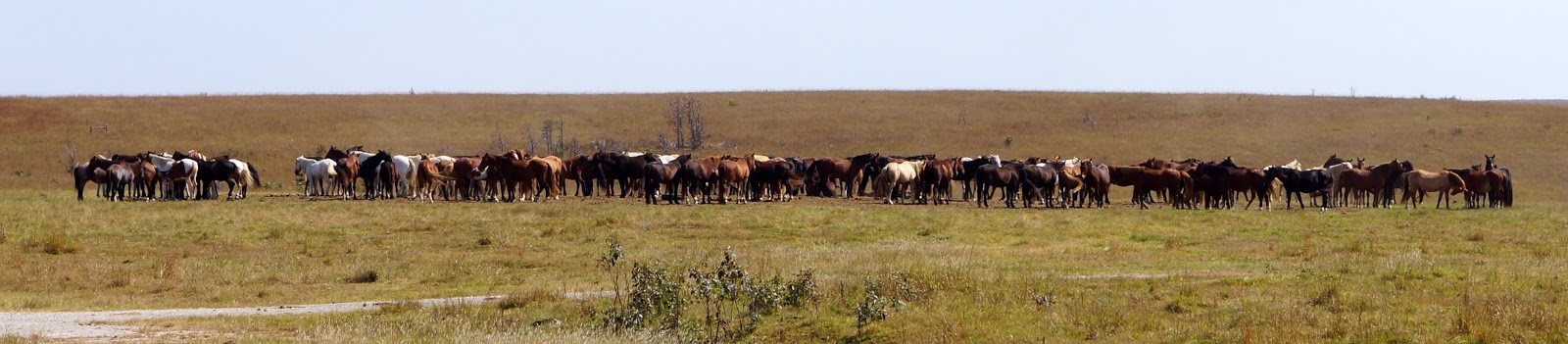
Bartlesville is right on the edge between the dry ranch land of western Oklahoma and the "Green Country" of northeast Oklahoma and the Ozarks.  On our way home from Wooleroc we passed the Hughes Ranch, home to up to 4,000 wild mustangs, depending on the year. We have only recently come to understand just how many wild horses there are the in USA.  In many places the herds are annually rounded up and thinned out by the hundreds so that they don't overwhelm the environments where they live. These horses are then sold or given away to places that will care for them, like the Hughes ranch.


These will probably be our last wild horses for awhile, as I think we are truly leaving the ranch lands of the west behind now, as we work our way south through the green hills of eastern Oklahoma and into Arkansas.