"Could I have this dance for the rest of my life?" - Anne Murray
Showing posts with label Oklahoma. Show all posts

Monday, October 26, 2015

In the Wilds of Oklahoma Where Bigfoot Roams

Fall in Oklahoma. It's not New England, but the oaks and a few other trees are showing off some color, and we're happy with that.


We were parked for a week in Big Cedar, at a small mom and pop kinda place, Big Cedar RV Park.  The sites are all grass, level, with full hook-ups, and mighty close together when the place is full. Fortunately, that rarely happens, so we were comfortable with open space around us. Their dog, Rusty, has the run of fields, trails and the many open spaces in the park and Honey got to play with him many times a day. 

Big Cedar RV Park (and cabins) 

Mena, the closest town with a grocery store, is about 30 miles away. We chose this location to be near the Talimena National Scenic Byway that runs from Mena, AR to Talihena, OK.  During our first RV trip, in the 19' rented Cruise America, we drove the Talimena in midwinter, in the fog. We saw absolutely nothing but the silohettes of black, bare, crooked, stunted trees on either side of the road as we traversed the high ridge. At the time it felt like a scene from a  Harry Potter story. Since then we've wanted to return to see what it looks like with leaves, and see what we missed from the overlooks.


The Talimena National Scenic Byway

One of those bare, gnarly, spooky trees in full leaf.

The  views from the many pullouts reminded us a lot of the Smoky Mountains in Tennessee.  Forest as far as you can see. It's a fun drive, especially in a car, and with no fog. Lots of elevation changes requiring low gear for trucks and RVs.   The whole drive probably takes a little over an hour, or more if you stop a lot for views and pictures. 


On football Sunday, Honey and I ventured south to Broken Bow Lake and Beaver Bend State Park.  We approached from the north on 259, but all the signage seems to be oriented toward folks coming up from nearby Texas. We had a really hard time getting oriented, or finding a visitor's center of any sort.  The main road through the park, Alternate 259 was washed out at the Mountain Fork River, (no forewarning) so we stopped and poked around there.  


Many large trees washed to the side of the river

Obviously the river can be much higher and more powerful than it was that day.  The banks are lined with colorful rocky ledges that were fun to climb around on.


On several other days Honey and I took hikes on the nearby Oachita Trail, a 223 mile single track, maintained trail through the wilds of eastern Oklahoma.  She's getting to be a real good hiker. If I let her off the leash, she'll stay close to me on the trail, and if she does wander off just a bit, she comes back to a whistle or an easy single call. I think she's a little nervous about being in a big new place, and so she stays close for security.


The trailheads for the sections we hiked were on the east and west sides of 259 less than a mile north of Big Cedar. The trail has no major elevation changes in that area, it just meanders and rolls through the woods, much of the time running along or across various streams. Sometimes the path is very rocky. It is marked pretty clearly with blue hatches on the trees and there are back-packer campsites every five miles or so. 


Our wildlife sightings for the hikes included a smallish black bear crossing the highway and this large walking stick in her fall wardrobe. 


Now it's time to confess one of my guilty secret pleasures.  On quiet, rainy days or late at night when I can't sleep I secretly search the internet for Bigfoot reports from wherever we happen to be and peruse videos on YouTube. Weird, I know. And the funny thing is, I've never been one of those people who reads the Enquirer in the grocery store line, but this feels a lot like that.  The only person I talk to about it is my son, who would also love Bigfoot to be real.  

Anyway, now the secret's out, and here we are in the midst of an area with one of the highest Bigfoot incident reports, in Oklahoma at least. We are parked in the middle of that dark orange county in the map below. That's La Flore County where there have been at least 23 Bigfoot reports. 

Retrieved from the Bigfoot Field Researchers Organization

Now to put that in perspective, here's a map of the frequency of Bigfoot reports in the US.  You can see there are areas where there are more reports than in rural eastern Oklahoma, such as Washington, Oregon, California, Florida, western Pennsylvania and Ohio. But this swath of territory running north to south through eastern Texas and Oklahoma has a pretty high count. 

Retrieved from Oklahoma Skeptic website

Although Honey and I did our best out in the backwoods of the Winding Stair Mountain National Recreation Area, we are sorry to report that we failed to hear, smell, see or capture a blurry video of Bigfoot. We'll try again in Florida.  


Thursday, October 15, 2015

Oklahoma City is Booming!

We are not city friendly folks, but after an overnight in Oklahoma City (OKC) we were impressed. Before we even knew the stats, we could tell it was thriving. So we looked it up while we were driving back to Grove. Here's what some of the numbers say:

OKC has grown 5% since the 2010 census according to a CNN Money article about the 10 fastest growing cities in the USA. According to Forbes, the unemployment rate was 3.1% in 2015.  The OKC Chamber of Commerce lists many accolades, including Entrepreneur's #1 for starting a new business. Its growth has traditionally been based in livestock and petroleum products, but new tech development has been recognized in the current and forecasted boom.

We loaded up Honey in the car and treated ourselves to a break from the RV so we could check out OKC.  We stayed at the La Quinta Inn, which always allows dogs without an additional charge and is usually a nice place. It was Honey's first visit to a hotel, and she was excited (of course she's always pretty excited), but she handled it well. We were able to leave her in the motel while we went out for dinner and to see the Capitol building the next day. But first we all went downtown to the Myriad Botanical Gardens, which has a dog park! It also allows pets throughout the gardens. Happy Honey!


She wasn't the only happy one. The temperature was delightful, the air was clean and crisp, and the garden was full of fun things to photograph. The landscaping was in Fall mode - end of season grasses, year round shrubs, evergreens and trees with a bit of Fall color. The park is very strong architecturally, with an emphasis on geometric forms rather than flowers, at least at this time of year.   


The primary focal point from almost every location is the Devon Energy Building. Everything else seems to play off that building. 


Down the center of the park is a ravine with a pond/river running through it. Pictured below is a foot bridge, many-leveled paths along the river and an amphitheater.


The river is fed and complemented by various other water features. Here Rick is taking a video  capturing the changing beauty of this wave pool.


The wave pool/waterfall is right next to a band shell...


...that was a lot of fun to photograph. Here it is in relation to the Devon Energy Building...


...and the sun.


A major feature of the park is the Crystal Bridge Tropical Conservatory...


...which houses, yes, tropical plants. We missed going in, as it closes at 5pm.


There is a restaurant, also closed when we were there.


We finished with another visit to the dog park. It's a small park with astro turf and gravel, but it has fresh drinking water for the dogs, bags, shade, and seating for the people. Honey got a little play time with another visiting dog, so she was all set for a quiet evening. 

Next day we left Honey in the hotel room again and went to the Oklahoma State Capitol.  It has an immediately noticeable unique feature: an oil well right in front. 


Also in front was this statue by Allan Houser, well known Native American sculptor, entitled "As Long as Water Flows." I guess the oil rig says "As Long as Oil Flows."  The economy in Oklahoma is certainly dependent on that flowing too.


The Capitol has what we now recognize as the traditional Capitol architectural plan modeled after the US Capitol: two major wings, and front and back entrance foyers with staircases, all extending away from a multi-storied central rotunda. 


Each state varies the design with unique murals, artwork, architectural detail, and color schemes that reflect the character of their state.  


There seemed to be less intrinsic symbolism in this building than the last four we've seen. There were however many references to Native American culture and history. 


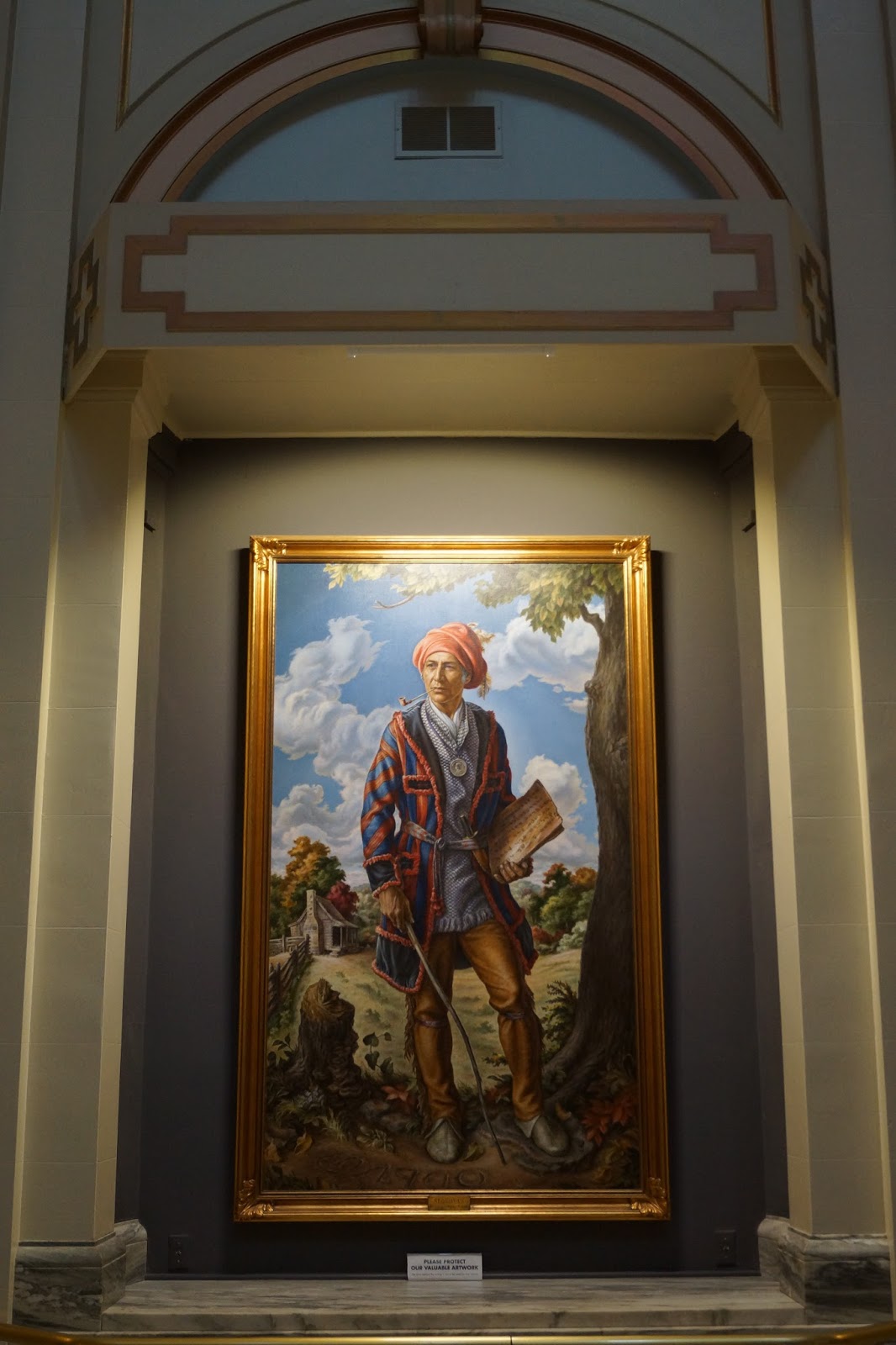
There is a striking collection of portraits throughout the building, including this one of Sequoyah, an illiterate (couldn't read or write any language) Cherokee man who single handedly invented and then taught the Cherokee alphabet and written language. He was also committed to the unification of the Cherokee Nation. 


One of the newest works of art in the Capitol is "Beyond the Centinnial" by Carlos Tello (2010).  The Iron Man-like figure in the center represents every Oklahoman, holding the future of the state in his hands. We thought it was a little bizarre.


Through the circle of lights below you can see one of the most beloved works of art in the building,  "Flight of Spirit" by Mike Larsen (1991). In the foreground it depicts five Native American ballerinas, with other Native dancers and artists behind them. One of the ballerinas is Maria Tallchief, whom I idolized as a little girl. 


This replica of the 22' statue called The Guardian, that tops the Capitol Dome, stands at the top of the front grand staircase.


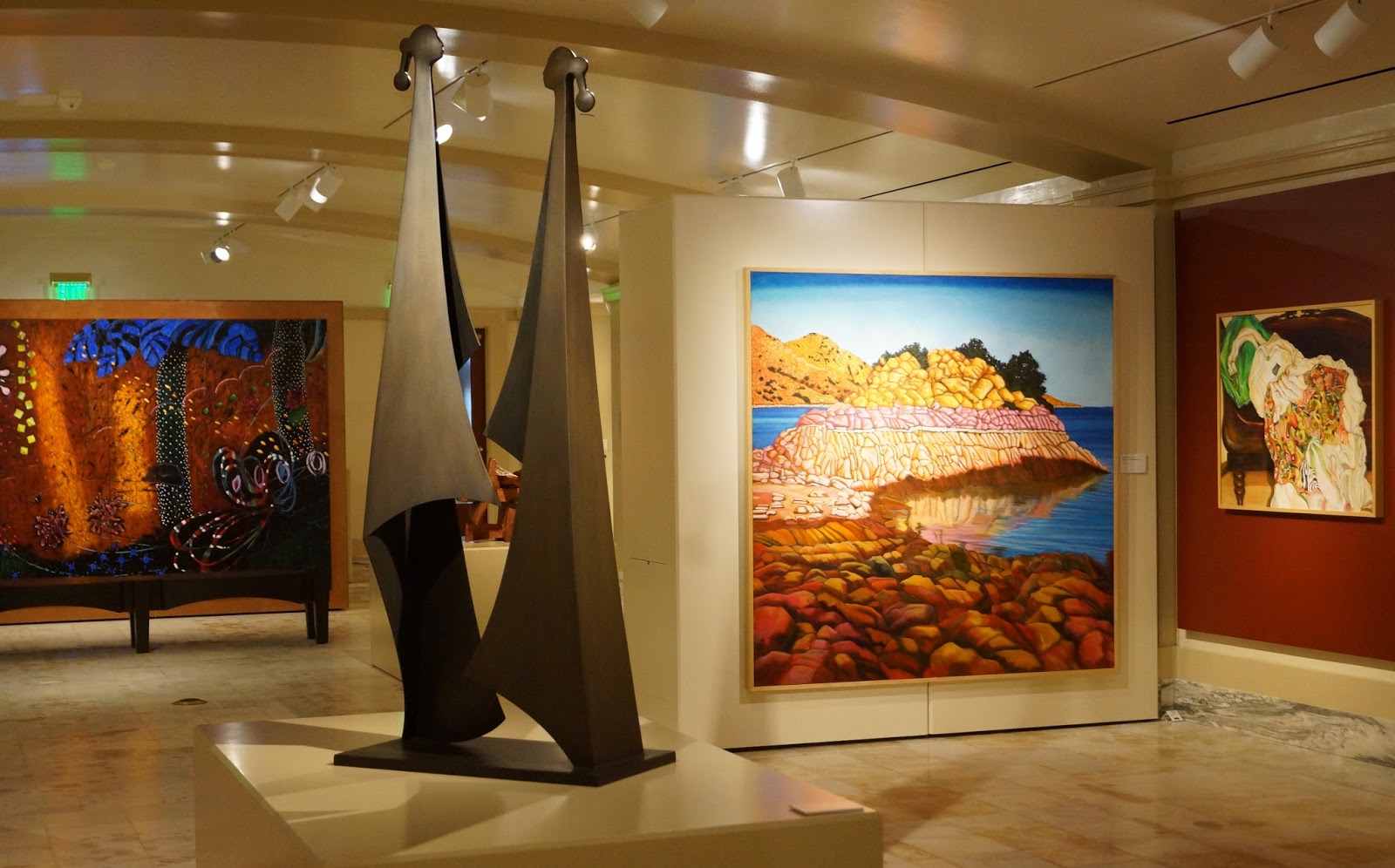
On the first floor there are several additional galleries that hold temporary displays; at this time they are wonderful contemporary collections. We thought the quality and selection of the art throughout the Capitol was remarkable and would recommend a visit to the building for any art lover. 


I'll close with this portrait of Woody Guthrie, one of my heroes. He was a singer/songwriter of the American people, from my parents' generation. I grew up singing his songs and didn't even know it.  I can't help but think how I learned of his worldview through music, a powerful medium, and how it influenced who I am and what I'm doing today.


This Land Is Your Land
Words and Music by Woody Guthrie

This land is your land, this land is my land
From California to the New York island;
From the red wood forest to the Gulf Stream waters
This land was made for you and me.

As I was walking that ribbon of highway,
I saw above me that endless skyway:
I saw below me that golden valley:
This land was made for you and me.

I've roamed and rambled and I followed my footsteps
To the sparkling sands of her diamond deserts;
And all around me a voice was sounding:
This land was made for you and me.

When the sun came shining, and I was strolling,
And the wheat fields waving and the dust clouds rolling,
As the fog was lifting a voice was chanting:
This land was made for you and me...

Monday, October 12, 2015

Oil heritage in Bartlesville, Oklahoma

Like we did, most readers probably think of Oklahoma as flat, dry, dusty and brown. But take a look at the satellite view of Oklahoma. About halfway through, from west to east, it starts to change from the omnipresent brown of the American West, to shades of green. At first it's just subtle, but by the time you reach the border of Arkansas, the green is deep and dark, like the Land of OZ compared to Kansas.  Oklahoma is definitely not just a big dust bowl.


We're spending a few weeks in the midst of all that verdant landscape in eastern OK. Of course, where you find green, you also find water; there are hundreds of lakes here, many of them very large reservoirs.  Right now we're parked on the shores of Grand Lake-o'-the Cherokees, one of the largest, at Cedar Oaks RV Park for a week.  Last week we were in Bartlesville, at the only RV park in town, Riverside RV Park. This post will be about our visit to Bartlesville where we first started seeing signs of the south: heavy vines hanging from the trees, armadillos on the side of the road and aisles of ham in the grocery store.

Bartlesville is the home of the first commercial oil well in Oklahoma and the Conoco Phillips Company (think Phillips 66). Scattered through the town there are small oil pumps and tanks, (in people's backyards, vacant lots, along the bike path) where a subtle, but not unpleasant aroma of crude oil lingers. 

There are several other attractions that Bartlesville is known for: Frank Lloyd Wright's Price Tower, Frank Phillip's home, and Frank Phillip's ranch and museum, Woolaroc. Our first stop was the Price Tower, behind the big 66 sculpture below.


One of only two built "skyscrapers" designed by Frank Lloyd Wright, the Tower was commissioned by Bartlesville oil pipeline businessman, Harold C. Price for his business.  Wright created it as a mixed purpose building with residences, retail and corporate offices throughout the building.


It is now used as an Arts Center, small hotel and restaurant, and is preserved for future appreciation.   We certainly appreciated it, especially after seeing so many of his other buildings in our travels. 


We took a tour through the building, but no photos were allowed. (I took the following two photos in the reception area before I was informed.) 


As with other FLW buildings, every little detail, like the vents, lights and all the furniture is designed to compliment the integrity of the whole. Another typical FLW feature is the built-in furniture, like the (uncomfortable) orange sofa bench below in the reception area. Before leaving we also had a good and reasonably priced lunch in the Copper Restaurant/Bar.


Right next door is the Bartlesville Community Center, designed by the Frank Lloyd Wright architectural firm, which we just appreciated from the outside.


Our next local adventure was Woolaroc, the ranch home of oilman Frank Phillips, founder of Phillips 66 Petroleum. It's about 12 miles outside of town, and is a combination wildlife refuge, historical home and museum, all created by Phillips in his lifetime.

Recreation of an old Phillips 66 gas station.

Uncle Frank was a funny guy.

Although Frank was an advocate of Native American culture and peoples, some of the representations on the ranch are a little dated.


Though he started out as a barber, after striking oil in Oklahoma Frank Phillips eventually became a very wealthy man. At his ranch home he entertained many people, some rich and famous, and some potential investors in his company. The log ranch house was built to entertain his guests.


Frank decorated his rustic cabin with the heads of domestic and exotic animals on his ranch that "died of natural causes." (The docent went out of his way to tell us that. Perhaps they've gotten some flak from animal protection folks.) There were A LOT of animal heads in that room. He also had a beautiful and extensive collection of Native American rugs and blankets both in the cabin and in the museum.


All the logs in the cabin are bark covered, but the bark was first completely stripped, soaked, finished, reapplied and sealed in a chemical process invented by Phillips' company.  They made picture frames for all the artwork in the museum with bark treated in the same manner. They even covered the Steinway piano in bark. (Can you imagine Mr. Steinway rolling over in his grave?

The bark covered Steinway

The dining room.

Our main reason for visiting Woolerac was the extensive museum that houses a vast collection of highest quality Native American artifacts and art, western American art and other historical collections.

Front door of the museum

We've seen lots of Native American museums in our travels, but something we really appreciated about this one was that it covered many different areas of the USA and many different tribes. This offered an opportunity to compare and contrast their cultures and aesthetics. There were also formal oil portraits of prominent tribal chiefs by a single artist, again offering a chance to appreciate the unique tribal regalia and characteristics.

Huge pottery collection

Rooms and rooms of art by and about Native Americans

My favorite item in the museum was this mechanical diorama of a Native American dance, complete with a recording of actual drumming and singing.  The dancing and drumming figures in the diorama all moved in rhythm with the recorded music that pulsed up from the base of the diorama through the floor. Whether jumping, turning, swaying, drumming or singing, the figures moved in a synchronous and surprisingly natural way.


Amongst the western art collection there was a fascinating display of twelve statues of "The Pioneer Woman" with huge variety in their style and imagery, ranging from a Venus-like near nude (third from the front below), to a harried working woman, to the older woman at the front of this photo. 


Most impressive was the huge exhibit entitled "The Best of the Best: Contemporary Wildlife Art" featuring seven painters and sculptures. We both could have spent hours in this room alone.


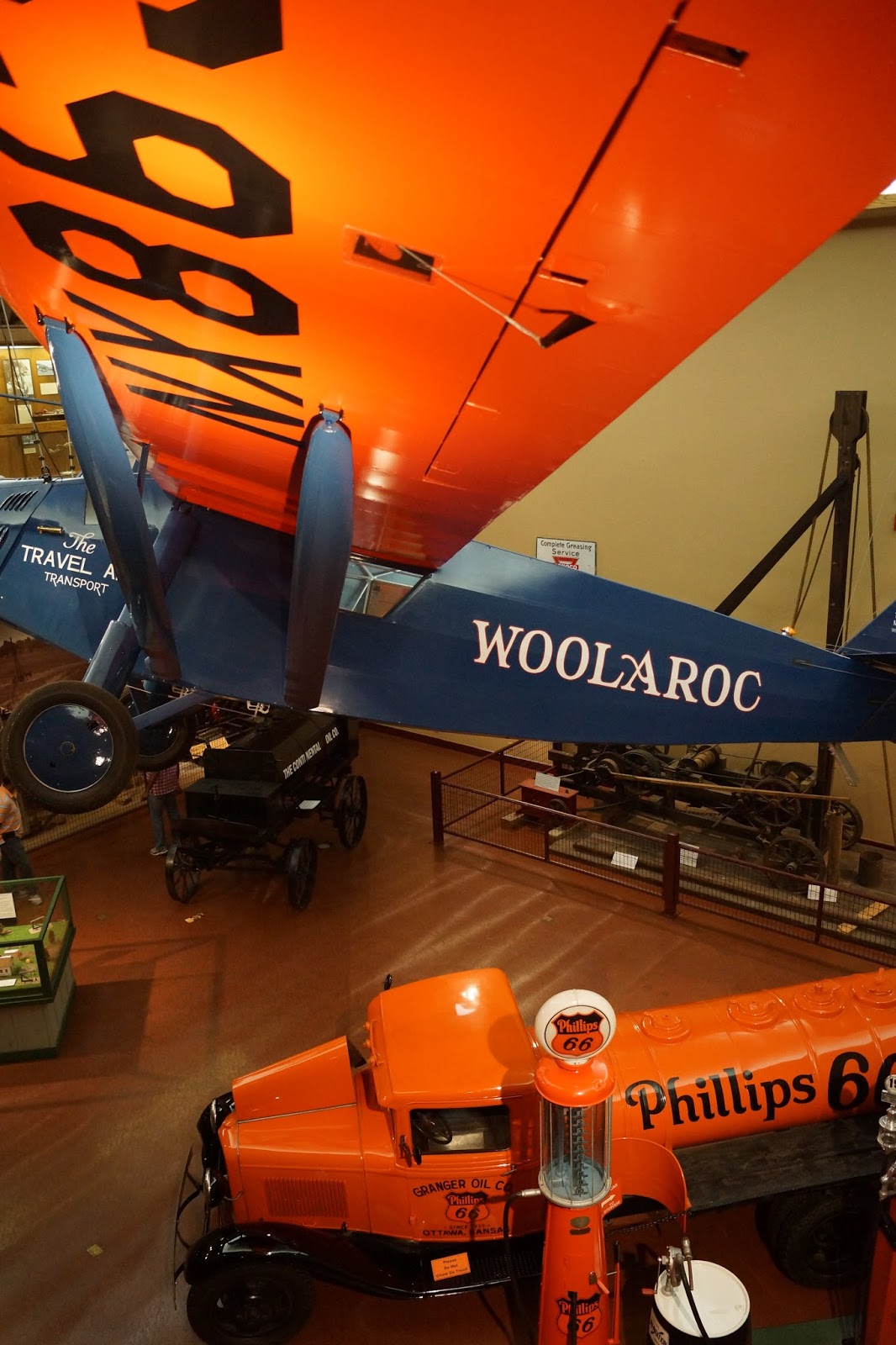
This is the airplane that started it all. The museum grew out of the need to find a place to keep the plane.


Phew! That was a full day.  The next day we visited the Phillips family home in town, which was much more traditional and seemed to reflect his wife Jane's personality while the ranch was all Frank.


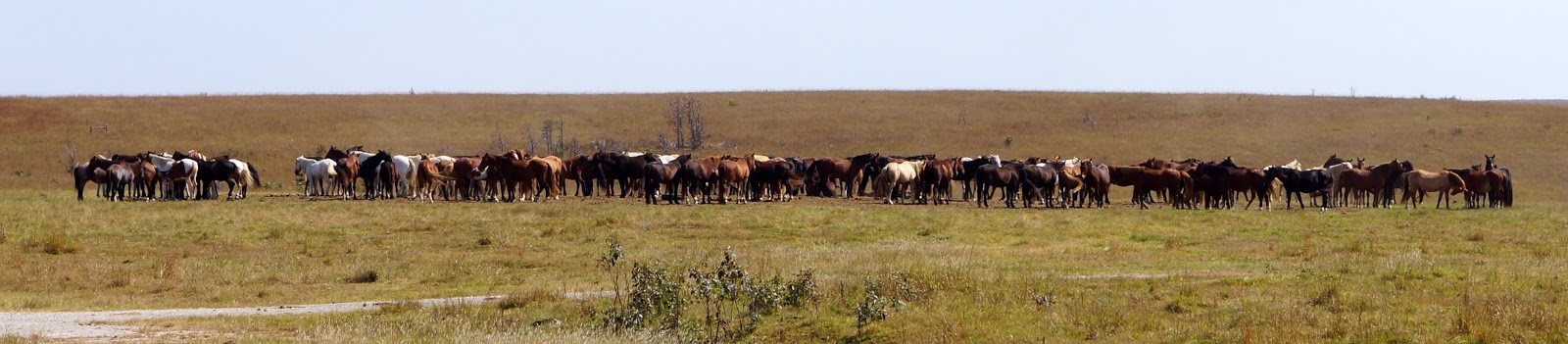
Bartlesville is right on the edge between the dry ranch land of western Oklahoma and the "Green Country" of northeast Oklahoma and the Ozarks.  On our way home from Wooleroc we passed the Hughes Ranch, home to up to 4,000 wild mustangs, depending on the year. We have only recently come to understand just how many wild horses there are the in USA.  In many places the herds are annually rounded up and thinned out by the hundreds so that they don't overwhelm the environments where they live. These horses are then sold or given away to places that will care for them, like the Hughes ranch.


These will probably be our last wild horses for awhile, as I think we are truly leaving the ranch lands of the west behind now, as we work our way south through the green hills of eastern Oklahoma and into Arkansas.